
Answer Engine Optimization — AEO — is the catch-all term for getting cited inside AI-generated answers across all the platforms that produce them: Google AI Overviews, ChatGPT, Perplexity, Claude, Gemini, Microsoft Copilot. Local SEO and AEO used to be different conversations. They aren’t anymore. Google AI Overviews now appear on a meaningful share of local intent queries, and when they do, the citation pool is the new local pack.
This post walks through what AEO means specifically for local service businesses, the citation patterns that distinguish AI Overviews from traditional local results, and the tactical changes that move local businesses from invisible to cited.
What AEO is
Answer Engine Optimization is the practice of structuring content so it gets cited as a source inside AI-generated answers across Google AI Overviews, ChatGPT, Perplexity, Claude, Gemini, and Microsoft Copilot. It overlaps heavily with traditional SEO — most AEO signals are also SEO signals — but the optimization targets are different. Traditional SEO targets ranking position; AEO targets citation inclusion.
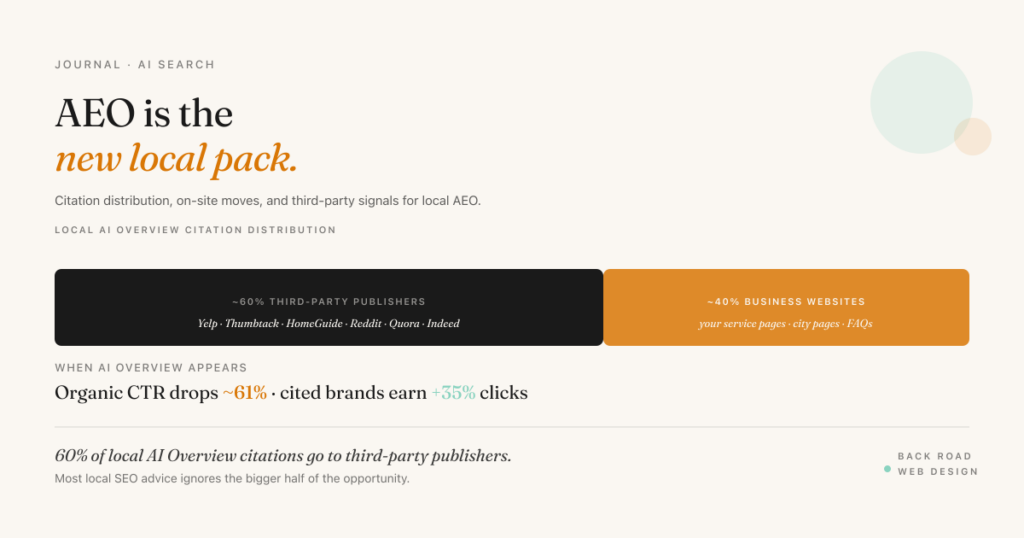
The economic case for paying attention has gotten unavoidable. A Seer Interactive analysis of more than 25 million organic impressions across 42 organizations between June 2024 and September 2025 showed organic CTR dropped roughly 61% when AI Overviews appeared in the SERP — from 1.76% to 0.61% — but brands cited inside the AI Overview earned approximately 35% more organic clicks than otherwise. An Ahrefs study of 300,000 keywords found average CTR drops of 34.5% on queries with AI Overviews present.
Translated: ranking #1 with no AI Overview citation now produces fewer clicks than ranking #5 with an AI Overview citation. The center of gravity has moved.
Where AI Overviews show up for local searches
AI Overviews don’t appear on every local query — yet. The pattern as of early 2026:
- High AI Overview frequency: “How to” queries, comparison queries, “best X for Y” queries, cost/pricing queries, “vs” queries.
- Medium AI Overview frequency: Service-specific queries with implicit comparison (“best plumber for emergency repairs in Paso Robles”), category-defining queries (“what is a podiatrist”), edge-case service queries.
- Low AI Overview frequency: Pure navigational queries (“Trader Joe’s near me”), brand-specific queries, transactional queries with clear single answers.
Who gets cited in AI Overviews for local queries
The citation distribution for local queries skews surprisingly. A Whitespark study of AI Overviews on local queries found roughly 60% of citations went to third-party publishers — Yelp, Thumbtack, HomeGuide, Indeed, ZipRecruiter, Reddit, Quora — and approximately 40% went to individual local businesses’ own websites.
That ratio matters because it tells you where to invest. For a local service business, the practical implication is:
- About half the citation opportunity is on your own site. Service pages, FAQ content, location-specific content with the right structure.
- About half is on third-party platforms. Getting reviewed on the right platforms, getting included in editorial roundups, having substantive content on Yelp, Thumbtack, or industry-specific directories.
Most local SEO advice still focuses entirely on the first half — “optimize your site.” That half matters but no longer dominates. The third-party half is where most local businesses are now under-invested.
The on-site changes that move citation rates
Citation-ready service pages
Restructure each service page so the very first paragraph contains the “answer capsule” — the citable block. This means:
- A specific price or price range (not “competitive pricing”)
- A specific service area (not “we serve the entire region”)
- A specific scope of what’s included (not “comprehensive service”)
- A specific timeline or response time (not “fast response”)
The contrast looks like this. Not citable: “We provide quality tree service to homeowners in San Luis Obispo County and the surrounding area, with competitive pricing and exceptional customer service.” Citable: “Tree removal in San Luis Obispo County typically runs $400–$2,800 per tree depending on size, location, and accessibility. We serve all of SLO County and northern Santa Barbara County, with same-week availability for non-emergency work and 24-hour response for emergency calls.”
Schema markup that AI engines recognize
The schema types that consistently move AEO performance for local service businesses:
- LocalBusiness schema with full NAP, hours, geo coordinates, and accepted payment methods
- Service schema for each individual service offered, with price ranges where possible
- FAQPage schema with the actual buyer questions you answer on the phone
- Article schema on blog and resource pages, with named author and verified credentials
- Review and AggregateRating schema tied to the LocalBusiness
Each schema type makes a different signal extractable. None alone is sufficient; together they materially increase the AI’s confidence in citing your business as a definitive source.
Topical clusters, not isolated pages
AI engines decompose complex queries and synthesize across sources. A site with a single “Services” page covering everything has one chance to be cited per query. A site with separate pages for each service, plus city-specific service area pages, plus FAQ content, plus a small library of how-to-choose content has many chances. On-page signals remain the largest factor group for local AI search visibility, accounting for roughly 24% of total weight in 2026 industry research.
The off-site work that matters
- Best-of inclusion. Pitch local publications and industry blogs for inclusion in roundup articles. “Best [service] in [city]” articles drive a disproportionate share of AI Overview citations.
- Substantive review content. Reviews are not just star ratings — the text content gets extracted by AI engines. Coach customers (without scripting) toward reviews that mention specific services, locations, and outcomes.
- Industry-specific directory presence. Healthgrades for medical, Avvo for legal, Houzz for contractors, AAA-listed businesses, BBB profiles. AI engines weight these as authority signals.
- Reddit and community participation. Where your audience talks about service decisions, having a knowledgeable presence (not promotional) creates citable mentions.
- Earned media in local outlets. Local newspaper coverage, community magazine inclusion, podcast appearances. The link itself helps with traditional SEO; the brand mention helps with AEO independently.
Tracking what’s working
AEO measurement is harder than traditional SEO measurement because the platforms don’t all expose citation data the same way. The realistic measurement stack:
- GA4 Search Console integration — shows AI Overview impressions but doesn’t separate them from traditional results.
- Direct query testing — periodically search Google, ChatGPT, Perplexity, and Gemini for the queries your buyers ask. Document who shows up. Repeat monthly.
- Brand mention tracking tools — platforms like Profound, Otterly, BrightEdge, and Ahrefs have started exposing AI citation data. Worth one of these for businesses serious about AEO.
- Referral tracking — Perplexity sends measurable referral traffic with a perplexity.ai source. ChatGPT does sometimes. Monitor in GA4.
The honest truth: deterministic AEO measurement doesn’t exist yet. The work is judged by leading indicators (citation share over time, referral traffic from AI sources, branded search lift) rather than by clean attribution.
Score your AEO readiness
Answer Engine Optimization · 8 Items
Score your local AEO readiness.
Want a custom audit of your AEO readiness?
I’ll test your buyer queries across Google AI Overviews, ChatGPT, and Perplexity, document where your business is cited (and where it isn’t), and send you a written report with the moves ranked by impact.
Get a free AEO audit →