
Central Coast Web Design: What Works for Service Businesses Across SLO and Santa Barbara Counties
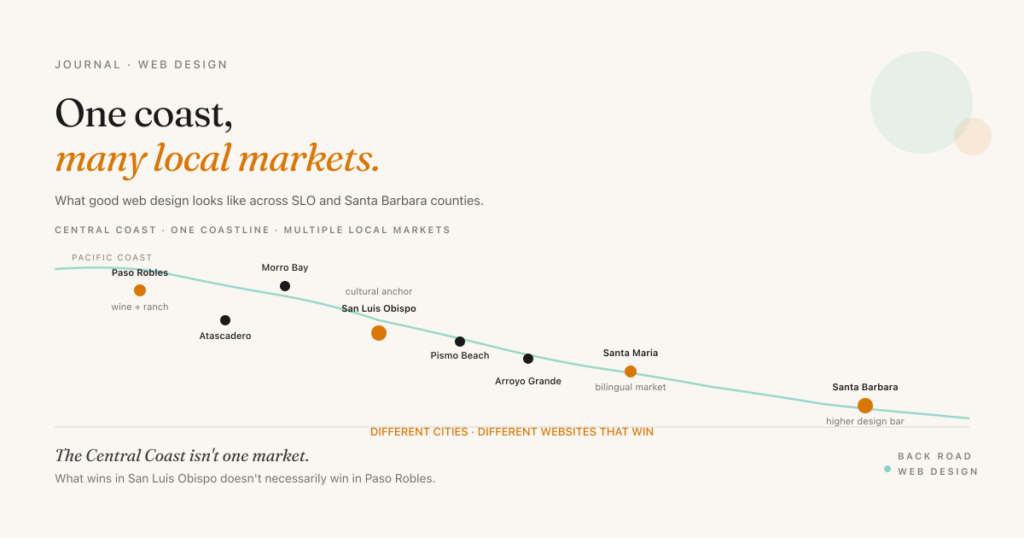
I work with service businesses across the Central Coast — San Luis Obispo, Paso Robles, Atascadero, Pismo Beach, Arroyo Grande, Morro Bay, Santa Maria, Santa Barbara. Each of these places has a different feel, a different competitive landscape, and different things customers care about when they’re hiring locally. The “we serve the Central Coast” sentence on a generic website misses all of that. This post is a working guide to what good website work looks like for service businesses in each of these communities.
It’s part audit checklist, part regional landscape — a way to think about what kind of digital presence fits the place you’re operating in, and what’s worth investing in versus what’s a distraction.
The regional landscape
Briefly, what the Central Coast service-business landscape looks like by area:
San Luis Obispo
The cultural and economic anchor of the region. Cal Poly, the courthouse, downtown thursday night, a higher-than-average concentration of educated and professional buyers. Service businesses here compete against polished competitors — most categories have at least a few well-marketed local options. Web design needs to look credible to a discerning audience without coming across as out-of-place corporate. The bar is “looks like it was built by someone who knows the area,” not “looks like it was templated from somewhere else.”
Paso Robles
Wine country with a working agricultural backbone. The competitive landscape is stratified — high-polish wineries and tourism businesses on one end, ranch and contractor businesses on the other. For service businesses, the audience is often a mix of locals and weekend visitors, which means the site has to work for both. Generic templates that don’t reflect Paso Robles specifically miss the chance to signal local roots.
Atascadero
Quieter, more residential, and underserved by polished local marketing. Many service businesses here still rely on word-of-mouth and have minimal web presence. That’s an opportunity — the bar is lower, but the trust required is higher. A clean, credible website with strong reviews and a clear local presence goes a long way here — the basics are still rare in this market.
Arroyo Grande and Pismo Beach
Coastal, tourism-influenced, with a mix of locals and visitors. Customer expectations skew toward warm, casual, and accessible — formal corporate web design reads as out of place. Service businesses here benefit from sites that signal “we live here, we know this area” through specific local references, real local photography (not stock), and substantive reviews from neighbors.
Morro Bay
Smaller, distinctive, marine-oriented. Service businesses here are usually small and tight-margin. Web design should be efficient — clean, fast, mobile-first, focused on conversion rather than impression. Most Morro Bay service businesses don’t need elaborate sites; they need ones that work.
Santa Maria
Larger, more diverse, more bilingual. Service businesses here often need to consider Spanish-language presence — at minimum a Spanish-language hero section or contact path on key pages, ideally a fully translated site for businesses serving primarily Spanish-speaking customers. Most local competitors haven’t done this; the ones that do tend to capture market share quickly.
Santa Barbara and Goleta
Higher-cost, higher-design-expectation. Service businesses here compete against more agencies, more polished sites, and a customer base that notices when something looks off. Web design needs to be considered, polished, and consistent with broader Santa Barbara aesthetic standards. The bar is meaningfully higher than in northern Central Coast markets.
What good Central Coast web design looks like
Across all of these communities, a few patterns consistently distinguish service business sites that work from ones that don’t:
Real local photography
Stock photos of people in business attire shaking hands fail. Photos of your actual location, your actual team, and visible Central Coast landmarks (Bishop Peak, Morro Rock, the Pismo dunes, Paso vineyards, Solvang windmills) do something specific — they signal you’re a real local business, not an outsider running a templated site. This matters for both human trust and AI engine entity verification.
City-specific service area pages
If you serve multiple Central Coast cities, each major service area should have its own dedicated page — substantive content, not templated swap-outs. The pattern that works is real local content: a tree service might mention the specific oak species common in that area, the typical lot sizes, the season-specific issues homeowners deal with there. A medical practice might mention how the office relates to local commute patterns or which insurance networks dominate that area.
Reviews from named local customers
“Sarah from Pismo Beach” or “Marcus, contractor in Paso Robles” outperforms anonymous testimonials by a wide margin. The location-specific anchor builds trust for prospective customers in the same area, and the substantive review text feeds the AI engines that increasingly mediate first impressions.
Fast load times on mobile
Service business buyers across the Central Coast skew heavily mobile — locals checking on their phones during work hours, tourists searching while standing in front of restaurants. A site that takes 5 seconds to render loses to a site that takes 1.5. Squarespace and well-built WordPress sites both hit the right speed targets when configured correctly; Wix and Shopify sites can struggle with this depending on theme and customization.
Conversion-clear CTAs
“Schedule a consultation” beats “Get in touch.” “Get a quote on tree removal” beats “Contact us.” “Book your tasting visit” beats “Inquire.” The general principle: the CTA should describe the specific action the buyer wants to take, not the generic “contact” verb. This is one of the easiest changes to make on most existing sites, and it consistently lifts conversion rates.
Platform choice for Central Coast service businesses
The right platform depends on the specifics, but a few honest framings:
- Squarespace. Excellent default for most service businesses. Beautiful templates, fast loading, easy to maintain without a developer. Limitations show up when you need complex booking flows, custom integrations, or deep CMS work.
- WordPress. Better when the site needs custom functionality, deep CMS work, or specific integrations. More maintenance overhead. The right choice for businesses that need to publish frequently or manage complex content.
- Shopify. Right when product sales (wine club shipments, online retail) are central to the business. Excellent commerce infrastructure; somewhat awkward for service-only businesses.
- Wix. Workable for small, simple sites where the business owner will maintain it themselves. The trade-offs on speed and SEO show up as the site grows.
For most Central Coast service businesses with no special requirements, Squarespace is the right starting point. For wineries with active wine clubs and product sales, Shopify often makes more sense. For practices and agencies with complex workflow needs, WordPress is usually the right call.
Score your Central Coast website
Central Coast Web Design Audit · 8 Items
Score your Central Coast site.
Want a custom audit of your Central Coast website?
I’ll review your site against the eight items above plus the specific patterns that matter for your community and category — then send you a written report with the moves ranked by impact.
Get a free Central Coast web design audit →