
ChatGPT SEO for Service Businesses: How to Get Cited When ChatGPT Recommends a Vendor
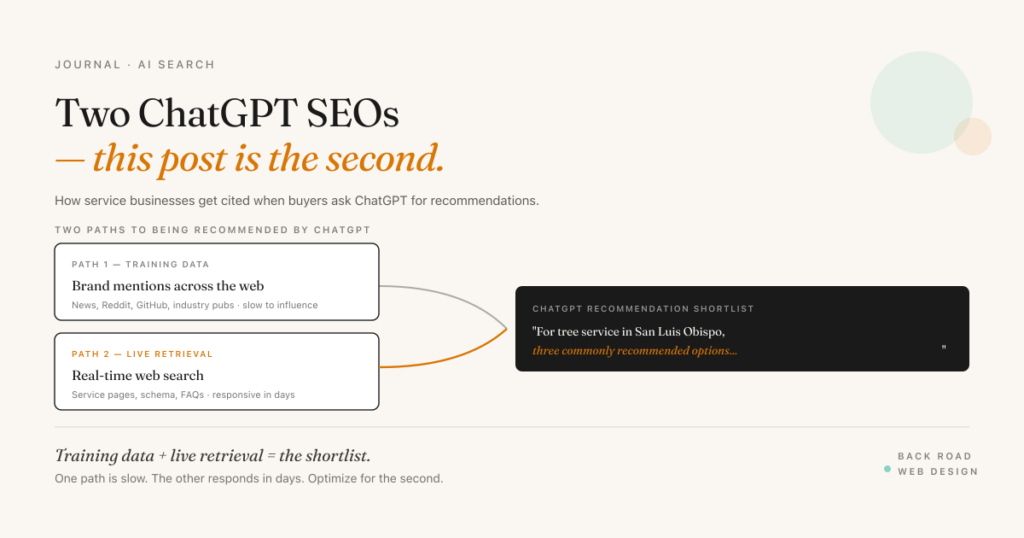
The phrase “ChatGPT SEO” gets used two completely different ways. The first version is “use ChatGPT to do your SEO work” — write meta descriptions, generate keyword ideas, draft outlines. That’s a productivity story. The second version is “rank inside ChatGPT” — show up when someone asks ChatGPT for a recommendation in your category. That’s a survival story. The second version is what this post is about, and it’s the one most service businesses are completely unprepared for.
This post walks through what it means to be “cited” by ChatGPT in 2026, the structural differences between ChatGPT search and Google search, the on-page changes that move citation probability, and the realistic expectations a service business should have about ChatGPT visibility right now.
Two different “ChatGPT SEOs”
Most articles using the phrase mean the productivity version — using ChatGPT as a tool to draft content faster. That’s fine, but it’s not really SEO. It’s content production. The version this post is about is meaningfully different: when a buyer asks ChatGPT “best digital marketing agency in San Luis Obispo” or “tree service near Paso Robles” or “podiatrist for plantar fasciitis” — what determines which businesses show up in the answer.
This matters because ChatGPT now handles a meaningful share of professional buying research. The shift is most visible in B2B and high-consideration purchases — someone vetting a vendor will often ask ChatGPT for a shortlist before they ask Google. For local service businesses, the shift is starting later but moving the same direction.
How ChatGPT picks who to mention
ChatGPT’s recommendations come from two sources, and the proportions matter:
- Training data — what ChatGPT “knows” about brands. The model was trained on a huge slice of the internet up through its knowledge cutoff. Brands mentioned frequently across that training data, particularly on authoritative third-party sites, get baked into the model’s associations. This is mostly out of your control day-to-day, but it’s why brand mentions in news articles, Reddit, GitHub, and major industry publications matter even if they don’t drive direct traffic.
- Browsing/search retrieval — what ChatGPT can find right now. When ChatGPT uses its search tool (which happens for most queries about current businesses, prices, or specifics), it retrieves real-time content the same way Perplexity does. This portion is much more controllable through traditional SEO + AI-friendly content structure.
For a local service business, the search-retrieval path is the bigger near-term lever. Training data shifts slowly. Search retrieval responds within days or weeks of content updates.
What a “ChatGPT-friendly” service page looks like
The structural patterns that produce ChatGPT citations look a lot like Perplexity patterns — these systems are converging on similar source-selection logic. The specifics:
- Concrete numbers and specifics, early. ChatGPT’s extraction layer rewards pages that put real information in the first paragraph: prices, response times, service areas, what’s included. As one citation researcher noted, the pages that get cited are usually not the ones ranking highest in Google — they’re the straightforward ones with clear answers, simple structure, definitions, and FAQs that are easy to extract and reuse.
- Definitive language over hedged language. “The best X is Y” gets cited; “Y might be a good option” doesn’t. The “lowest entropy” answer wins — meaning the most specific, unambiguous claim that resolves the user’s question.
- Comparative framing. “When to choose X vs Y,” “Three booking models for medical practice scheduling,” “Five things to look for in a tree service contractor.” Comparative content earns dramatically more citations than narrative content.
- Server-side rendered HTML. ChatGPT’s crawlers are less aggressive than Google’s about rendering JavaScript. If your site relies on heavy client-side rendering to display key content, the model may see a blank page. WordPress and Squarespace handle this fine; some custom React sites don’t.
- FAQ schema with the actual buyer questions. Not “What is plumbing?” — questions like “How much does emergency drain cleaning cost in San Luis Obispo?” or “Do you accept Anthem Blue Cross for podiatry visits?”
The third-party signal layer
ChatGPT (and the GPT-based AI Overviews and Copilot variants) don’t just look at your website. They synthesize across the web. That means three external surfaces matter:
1. Listicle inclusion
“Best tree service contractors in San Luis Obispo,” “Top medical practices in Paso Robles,” “Recommended digital marketing agencies on the Central Coast.” When ChatGPT is asked for recommendations, it heavily favors brands that already appear in lists like these. Getting included usually requires actively pitching local publications, industry blogs, and review sites — not just hoping for organic mention.
2. Reddit and community discussions
For service categories with active subreddits or community forums (r/SLO, industry-specific subreddits), genuine participation produces lasting AI visibility. The bar is “be helpful, mention experiences honestly when relevant” — not promotional spam. ChatGPT actively pulls from Reddit when users ask service-recommendation questions.
3. Review platforms with substantive review text
Yelp, Google reviews, industry-specific platforms (Healthgrades for medical, Avvo for legal, Houzz for contractors). Reviews matter for star ratings, but the text content of reviews matters separately for AI extraction. A review that says “They removed three large oaks from our property in Atascadero in one day, came in $400 under estimate” is dramatically more useful for AI than “Great service!”
Realistic expectations for ChatGPT visibility
Three honest things to know before you invest in this:
- Tracking is hard. ChatGPT, unlike Perplexity, doesn’t reliably send referral traffic with a “chatgpt.com” referrer. Some queries do; many don’t. The most reliable measurement approach is direct testing — periodically asking ChatGPT the queries your buyers ask and checking if/how your business shows up.
- Results compound, but slowly. A perfectly-optimized service page might start showing up in ChatGPT recommendations within weeks. Building the third-party signal layer takes months. There’s no overnight result here.
- This is additive, not a replacement for Google SEO. Most of the signals that matter for ChatGPT citation also matter for Google ranking. The work overlaps substantially. The mistake is treating ChatGPT SEO as a separate channel — it’s a different lens on most of the same work.
For a service business that’s already done the basics on Google SEO, layering ChatGPT-friendly structural changes on top is a high-leverage 30–60 day project. For a business that hasn’t done Google SEO basics, ChatGPT optimization shouldn’t be the priority — fix the foundation first.
The 60-day ChatGPT visibility plan
- Weeks 1–2 — Establish baseline. Test ChatGPT for 8 of your most important buyer queries. Document who currently shows up. Note the specific phrasing ChatGPT uses to describe each business — that’s a clue to what content the model has indexed.
- Weeks 3–4 — Restructure top pages. Apply answer-first structure, add FAQ schema with buyer questions, include named authors on key pages, verify server-side rendering of critical content.
- Weeks 5–8 — External signals. Pitch one local publication for inclusion in a “best of” piece. Identify two relevant subreddits or community forums and start participating helpfully (not promotionally). Audit Yelp/Google reviews and start a review-quality program that rewards detailed, specific reviews.
- End of week 8 — Re-test. Run the same eight queries from week 1. The results won’t be transformed, but if you’re doing this right, you’ll see at least a couple of queries where the answer changes meaningfully.
Score your ChatGPT readiness
ChatGPT SEO Readiness · 8 Items
Score your ChatGPT visibility readiness.
Want a custom audit of your ChatGPT visibility?
I’ll test ChatGPT for the queries your buyers actually ask, document where your business shows up (or doesn’t), and send you a written report with the moves ranked by impact.
Get a free ChatGPT SEO audit →