
Perplexity now handles roughly 100 million queries a week and is the fourth-largest AI platform globally — and the people using it skew heavily toward research-oriented, technical, and high-income users. For service businesses, that demographic mix matters: someone asking Perplexity “best podiatrist in San Luis Obispo” is closer to booking than someone scrolling Yelp. Industry research suggests visitors arriving from AI citations convert at meaningfully higher rates than typical Google organic visitors. The catch is that Perplexity doesn’t really rank pages — it cites them. And almost no local service business is optimizing for that game yet.
This post walks through what Perplexity SEO actually means for a local service business, the citation logic that determines who gets pulled into answers, the on-page changes that consistently increase citation rates, and a realistic 30-day plan that stops short of the “boil the ocean” approach most agency content recommends.
Why Perplexity is different from Google
Google ranks pages in a list and lets the user pick. Perplexity reads dozens of pages, synthesizes an answer, and cites a handful of sources inline. The user often never clicks through — but the brand mentioned in the answer becomes the answer to the question.
This shifts what “winning” looks like:
- In Google: rank #1, get the click, convert the visit.
- In Perplexity: get cited, build brand association with the answer, capture the click sometimes and the trust always.
Independent research suggests Perplexity uses a three-layer reranking system with an XGBoost quality gate that filters for entity clarity and authoritativeness, with a manually curated authority domain list that gives algorithmic boosts to sources from platforms like GitHub, LinkedIn, and Reddit. That’s a meaningfully different game from Google’s link-based ranking.
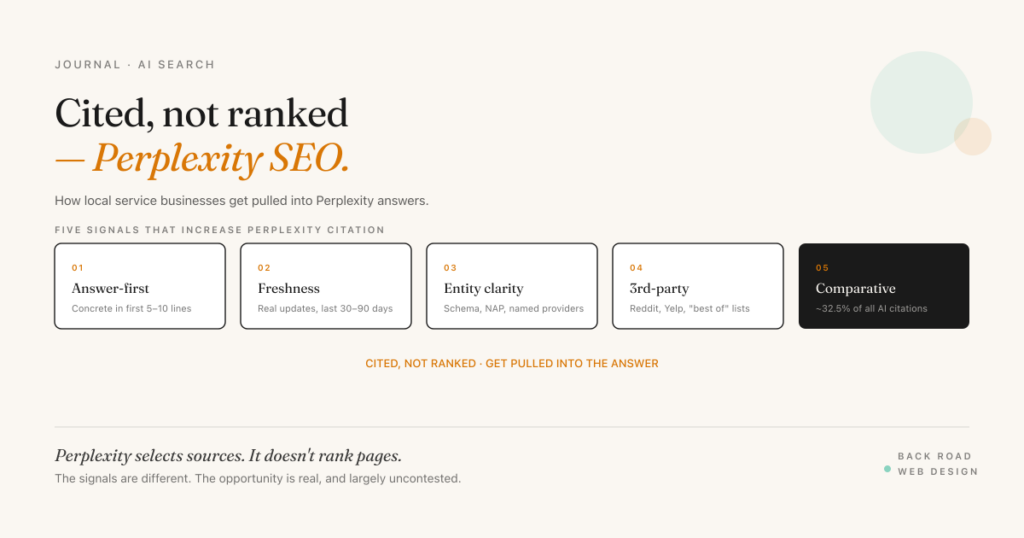
The five signals Perplexity rewards
1. Answer-first content structure
Perplexity needs to extract a clear answer from your page in the first 5–10 lines. Pages that bury the answer behind paragraphs of context don’t get cited — Perplexity’s extraction layer can’t easily pull a quotable passage. The simple test: read the first paragraph under each H2 on your service pages. If it answers the question implied by the heading, the page is structured for citation. If it’s introductory throat-clearing, it isn’t.
For a local service business, that means rewriting service pages so the very first lines under each heading state concrete facts — pricing range, response time, service area, what’s included — instead of marketing prose.
2. Content freshness
This one’s bigger than most agencies admit. Analysis of more than 17 million AI citations found AI-cited content is roughly 25.7% fresher than the typical Google-ranked organic result, with content updated within 30–90 days cited at substantially higher rates than older pages. Pages that ranked steadily on Google for three years can quietly stop earning AI citations within a single quarter.
The practical implication: a “set and forget” service page is dying as an AI strategy. Pages need real updates — not date-stamp tricks, but genuine content updates that reflect current pricing, current service offerings, current customer outcomes.
3. Entity clarity
Perplexity’s models work better when they can identify the specific entity (business, location, service) being discussed. That means consistent business name across the site, GBP, and any third-party listings; a clear LocalBusiness schema with accurate NAP data; and concrete entity references in content (specific city names, specific service names, specific provider credentials). Vague references like “the local area” or “our team of experts” provide nothing for the model to anchor to.
4. Third-party authority signals
Perplexity heavily weights mentions on what it considers authority domains. Reddit citations in AI overviews grew approximately 450% from March to June 2025, and Perplexity has been observed citing Reddit roughly 45% more frequently than other sources. That’s not a Reddit-marketing story — it’s a “your brand needs to be discussed in the wild” story.
For local service businesses, the practical play is being included in:
- “Best of [city]” articles and roundups in local publications.
- Industry-specific directories with real editorial standards.
- Yelp, Thumbtack, HomeGuide listings with substantive review content (Perplexity treats these as third-party citations).
- Reddit threads where people are asking the questions your business answers — not as a self-promoter, but as a knowledgeable participant who happens to mention experiences honestly.
5. Comparative formatting
This one surprised me when I first saw the data. An analysis of 177 million AI citations found comparative listicles account for roughly 32.5% of all AI citations — more than double the next-closest format (opinion blogs at about 9.91%).
For a service business, that means content like “Five things to look for in a tree service contractor,” “Three booking models for medical practice scheduling,” “How to compare Google Ads management for service businesses” earns citations at meaningfully higher rates than narrative or pure-marketing content. Not because comparative content is better in some abstract sense — but because AI extraction works better on it.
What Perplexity SEO looks like for a local service business
The work breaks into three layers, in priority order:
Layer 1 — Extraction-friendly service pages
The first tactical move is rewriting your top three service pages so each one opens with a direct answer to the implied question. For a tree service: “What does tree removal cost in [city]?” → the first paragraph should give a real range, the factors that change it, and what’s included. For a medical practice: “What insurance does the practice accept?” → list the specific plans accepted, not “we accept most major insurance.”
This is also the layer where schema markup matters. LocalBusiness schema with specific service offerings, FAQ schema with the actual questions buyers ask, and Article schema with named author bios all increase the surface area Perplexity can extract from.
Layer 2 — Topical depth
Perplexity decomposes complex queries into sub-queries and retrieves sources for each. A site with separate pages covering pricing, process, and city-specific service has three chances to be cited on a single complex query. A site with one generic services page has one. The lesson isn’t “publish more content” — it’s “don’t combine separate topics into single pages.”
For most local service businesses, this means service-by-service pages, city-by-city service area pages, and a small library of “how to choose” content that targets the comparison-stage queries.
Layer 3 — External presence
The off-site work — getting included in roundups, building substantive review content, participating in Reddit threads where genuine expertise is welcome. This is the slowest layer to build but the one that compounds longest. The 2026 Local Search Ranking Factors survey identifies citations as roughly 13% of total AI search visibility weight, with on-page signals the largest factor group at about 24%.
The 30-day Perplexity action plan
For a local service business starting from zero, here’s a realistic four-week sequence:
- Week 1 — Audit citations. Search Perplexity for 5 of your most important service queries (e.g., “best tree service in San Luis Obispo,” “Pinot Noir tasting room Solvang”). Note which domains get cited. The list of who’s currently winning IS the list of who you’re competing with.
- Week 2 — Rewrite the top three service pages. Answer-first structure, real entity references, FAQ schema, named author. Update the modification date on the page legitimately by adding genuinely new content.
- Week 3 — Strengthen GBP and third-party signals. Detailed Q&A entries, weekly posts, request reviews that mention the specific service and city. Get included in at least one local “best of” article (this often takes pitching).
- Week 4 — Set up tracking. Add Perplexity referral tracking in GA4 (it sends real referral traffic, unlike ChatGPT). Set a calendar reminder to re-check Perplexity for the same five queries 60 days later.
That’s not a complete AI search strategy. It’s a starting move that produces measurable results in the timeframe a business actually has.
Score your Perplexity readiness
Perplexity SEO Readiness · 8 Items
Score your Perplexity citation readiness.
Want a custom audit of your Perplexity citation readiness?
I’ll search Perplexity for the queries that matter to your business, document who’s currently being cited, and send you a written report with the specific moves ranked by impact.
Get a free Perplexity SEO audit →