
Funk Zone Winery Marketing: Tasting Room Strategy When 20 Competitors Are Walkable
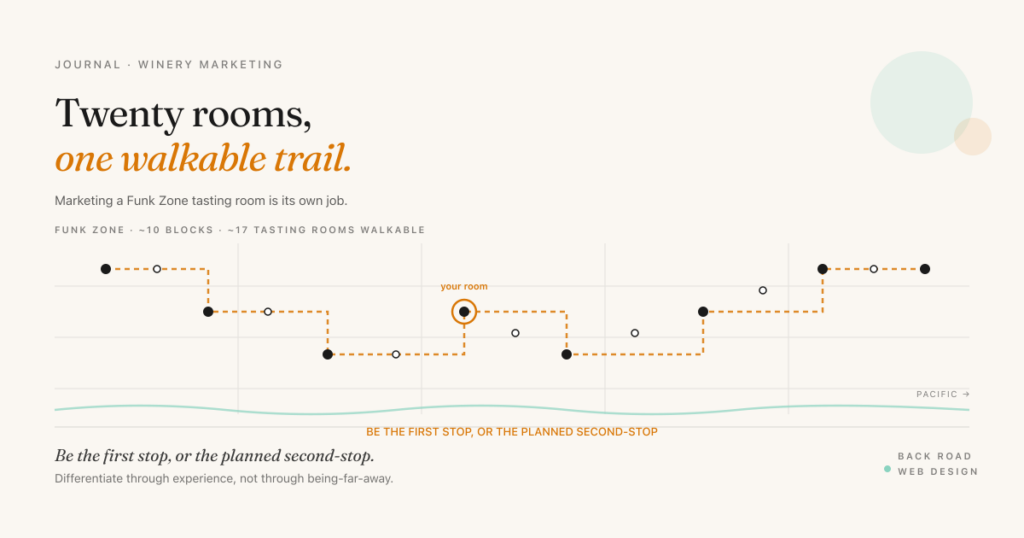
The Funk Zone is a different animal from Santa Ynez Valley. Ten blocks, a couple of hundred yards from the Pacific, twenty-plus tasting rooms walkable in a single afternoon, no estate vineyards in sight. Visitors come for the urban tasting trail, the murals, the ramen-and-rosé Friday night vibe — not for the bucolic hill-country experience. Marketing a Funk Zone tasting room like it’s a Solvang estate winery doesn’t work. Marketing a Funk Zone tasting room well is a specific job with its own playbook.
This post walks through the Funk Zone audience reality, the Urban Wine Trail context, the local-traveler mix that drives weekday traffic, and the digital infrastructure that fits an urban tasting room better than the rural-winery defaults.
What the Funk Zone is
The Funk Zone sits between State Street and Garden Street, with Cabrillo Boulevard and the Pacific to the south, Highway 101 to the north. It’s a roughly 10-block area of converted warehouses with graffiti murals and contemporary art, host to a major portion of the Santa Barbara Urban Wine Trail’s 20+ tasting rooms.
The transformation from gritty warehouse district to wine-and-art destination happened roughly post-2010, accelerating sharply around 2015–2018. The neighborhood now anchors a particular kind of Santa Barbara visitor experience: the day trip from LA or the Bay Area where the visitor doesn’t want to drive 45 minutes to Santa Ynez Valley but still wants the wine country experience. The Funk Zone delivers a compressed, walkable version of that experience.
That structural fact shapes the marketing. Funk Zone tasting rooms compete with each other intensely — twenty rooms in walking distance creates a bake-off — but the total visitor pool is enormous. The neighborhood concentrates demand the way Solvang or Los Olivos do, just compressed into ten blocks.
Three audiences, all walkable
The visitor mix in the Funk Zone breaks down into three groups, each with different marketing entry points:
1. Day-trippers from LA and the Bay Area
This is the largest segment. People who drive up Highway 101, park near the train station or East Beach, and spend the day walking from tasting room to restaurant to gallery and back. They’ve usually researched the area before arriving — Yelp, Google Maps, “best Funk Zone wineries” searches.
To capture them, you need to rank for those exact searches. “Best wineries in Funk Zone Santa Barbara,” “Urban Wine Trail must-visit,” “Funk Zone wine tasting” — high-intent searches that happen during trip planning. Most of the ranking is done by aggregator sites (VisitSantaBarbara.com, Wine Enthusiast, travel blogs), but specific Funk Zone tasting rooms can rank for branded and semi-branded queries — “[your room name] reviews,” “Pinot Noir tasting Funk Zone,” “best sparkling wine Santa Barbara waterfront.”
2. Tourists in town for other reasons
Conferences at the Hilton, weddings at El Capitán, family vacations centered on the beach. They’re in Santa Barbara for a reason that isn’t wine, but they’re available for an afternoon or evening. The marketing entry point here is in-room and concierge marketing, partnerships with hotels, and Google searches for “things to do near [hotel name].”
Concrete moves: deliver promotional cards to the four or five major hotels’ concierges. Get a Visit Santa Barbara listing. Get on the major hotel-concierge digital recommendation lists where possible (some hotels have these, some don’t). Run small-budget Meta ads geo-fenced to a 1-mile radius around major hotels with hotel-staying audiences.
3. Locals on weekday afternoons
Santa Barbara residents who walk to the Funk Zone for a Tuesday afternoon glass or a Thursday evening event. This is the smallest segment by volume but the highest LTV — locals who become regulars come back monthly, refer friends, and join wine clubs at a higher rate than tourists.
The marketing channel here isn’t search — locals already know about the Funk Zone. It’s email newsletters, Instagram (locally followed), and event programming that creates a calendar reason to come on a specific weekday. Many of the patterns from the off-season tasting room playbook apply directly here.
The Urban Wine Trail SEO context
The Santa Barbara Urban Wine Trail is the umbrella brand for the cluster of tasting rooms across the Funk Zone, Presidio District, Haley Corridor, and a few other downtown pockets. It has its own website, its own newsletter, and significant SEO authority for trail-related searches.
For an individual Funk Zone tasting room, this is mostly an opportunity. Being listed on the Urban Wine Trail website and being included in their Trail Pass program adds discovery surface area you can’t replicate on your own. The reverse is also useful — linking from your site to the Urban Wine Trail website signals to Google that you’re a legitimate participant in the regional wine cluster.
What it isn’t: a substitute for your own SEO. The Urban Wine Trail homepage ranks for “Santa Barbara wine trail” and similar searches, not for “[your tasting room] tasting” or “[varietal] Funk Zone.” Those rank-for-yourself wins still need your own pages.
Differentiation when twenty competitors are walkable
Rural wineries differentiate partly by being far from each other — the drive itself is part of the experience. Funk Zone tasting rooms can’t differentiate that way. The differentiation has to come from what’s specifically inside the room. Successful Funk Zone tasting rooms tend to specialize:
- Single-AVA focus. A tasting room exclusively pouring Sta. Rita Hills wines, or Ballard Canyon-only Rhônes, gives the visitor a coherent reason to start (or end) their Trail walk there.
- Single-varietal depth. A Pinot-only or Chardonnay-only room signals expertise. Visitors looking specifically for that varietal go directly there.
- Distinctive experience format. A guided seated flight vs. a counter-pour stand-up. A vinyl-and-wine evening on Thursdays. A specific food pairing program.
- Distinctive winemaker access. A tasting room where the winemaker actually pours on certain weekends, with educational depth that aggregator-style trail walking can’t match.
The website needs to convey this differentiation in the first 5 seconds — what makes this room specifically worth choosing among the twenty options on the Trail. Generic “we make great wine in Santa Barbara County” copy fails because every other room on the Trail says some version of the same thing.
Reservations vs. walk-ins
Funk Zone tasting rooms split between “walk-ins welcome” and “reservations required.” Both approaches work, but they require different marketing.
- Walk-in rooms compete on visibility and proximity to foot traffic. Marketing emphasis: signage, Google Maps presence, walk-up appeal in photos.
- Reservation rooms compete on the perceived value of the experience. Marketing emphasis: detailed experience descriptions, photos that signal scarcity (small group seated tastings), reservation platforms that allow same-day booking.
A common mistake: requiring reservations without giving the visitor a strong reason why. If the experience is essentially a walk-up flight in a more curated setting, the reservation friction outweighs the value. If the experience is genuinely different — guided, food-paired, winemaker-led — the reservation makes sense to the visitor.
Score your Funk Zone tasting room readiness
Funk Zone Tasting Room Audit · 8 Items
Score your Funk Zone tasting room.
Want help marketing your Funk Zone tasting room?
I’ll review your website, GBP, Urban Wine Trail listing, and reservations setup — then send you a written report with the specific moves ranked by impact for your room.
Get a free Funk Zone tasting room audit →