
Wine Club Marketing in 2026: How High-Retention Clubs Compete on Experience, Not Just Bottles
Wine clubs are now the largest direct-to-consumer revenue channel in the American wine industry. They surpassed tasting room sales in 2022 and have widened the gap since. For most wineries, club revenue is more predictable than tasting room revenue, has higher margins, and produces customers who refer other customers. The strategic case for the wine club has never been stronger.
The execution case is harder than ever. Industry data points to a retention crisis — average club tenure is shrinking, first-year cancellation rates are climbing, and members increasingly cite “better deals elsewhere” as the reason they’re leaving. The wineries succeeding right now have moved past treating the club as a “subscribe-and-save” program and started treating it as a membership experience. This post walks through what that shift looks like in practice.
The retention numbers worth knowing
A few specific data points anchor the strategy:
- Wine clubs now account for about 39% of all DTC wine sales. Wine clubs have surpassed tasting room sales as the primary DTC revenue channel and continued widening the gap since 2022.
- The average winery wine club holds about 1,700 members. Sized like a mid-sized country club, but with a different retention dynamic.
- Country club retention runs 92–94%; wine club retention runs 64–77%. That gap is the central challenge in wine club operations — 2.5x to 3x the attrition of a comparably-sized membership business.
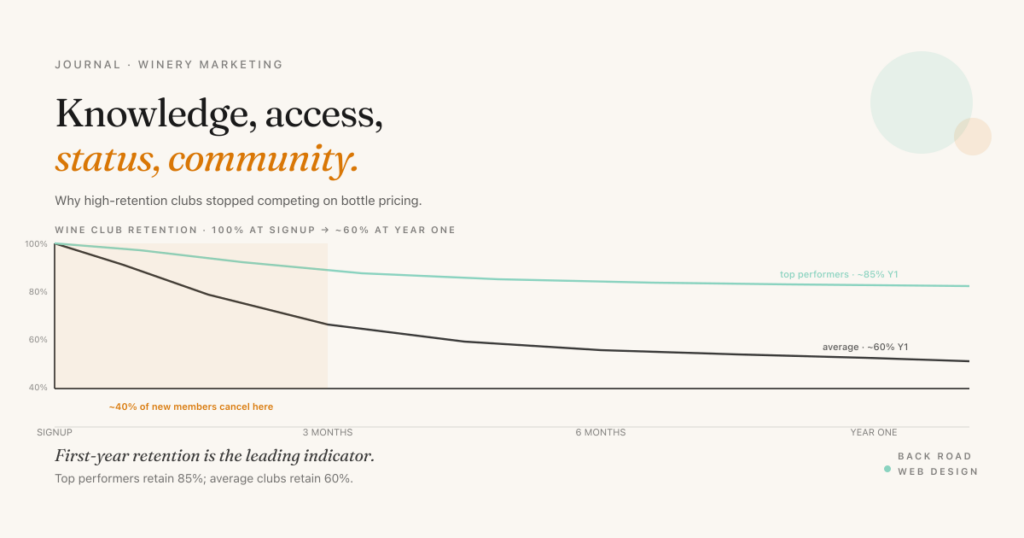
- About 40% of new wine club members cancel within the first year. First-year retention is the leading indicator of long-term club health.
- 48% of cancellations cite “better deals elsewhere,” up from 31% in 2022. Price-driven attrition is rising, and bottle-discount-only club value propositions are losing competitive ground.
- Top-performing wineries hit retention rates above 85% past year one. The gap between average and top-quartile is enormous.
These numbers come primarily from Private Club Marketing’s analysis of SVB, Sovos, Wine Market Council, and WineBusiness Monthly data, plus the Wine Industry Advisor’s coverage of the 2026 retention crisis. The picture is consistent across sources.
The four retention currencies
The frame I find most useful for thinking about wine club retention comes from Highway 29 Creative’s analysis of SVB research: high-retention clubs offer at least three non-product benefits in addition to the wine itself. The four “currencies” they identify:
- Knowledge currency. Winemaker video notes specific to the shipment, vintage explainers, vineyard-source background. Education that the member couldn’t easily find elsewhere.
- Access currency. Allocation-only releases that don’t go to retail, virtual tastings with the winemaker, vineyard-walk events, harvest dinners. Access to things non-members can’t buy or do.
- Status currency. Member recognition that’s visible to other customers — named tiers, member-only seating in the tasting room, anniversary acknowledgments. Status that signals “I’m part of this.”
- Community currency. Connection to other members. Member-only events that aren’t just about the wine but about the shared interest. Wineries that build active member communities — even loose ones — see materially higher retention.
Wineries running pure subscribe-and-save clubs offer one currency (the wine itself, with a discount). High-retention clubs offer four. The math of switching to a competitor is different when the cost of leaving is “I lose the discount” vs. “I lose the discount, the winemaker access, the named-tier status, and the community I’ve gotten to know.”
The first-year retention problem
First-year cancellation is where the leverage is. Members who make it past 12 months retain at much higher rates; members who leave in the first year often join during a tasting-room visit, get one or two shipments, and lose interest before any real bond forms.
The interventions that move first-year retention:
- Welcome-period programming. The first 30 days set the tone. A welcome email sequence that introduces the winemaker, sets expectations for the first shipment, and offers a low-friction first event (virtual tasting, in-person event when relevant) makes the early experience feel like onboarding into a community, not just a billing relationship.
- Personal outreach in the first 90 days. A call or personalized email from someone on the team in the first quarter. Doesn’t have to be the winemaker; can be the club manager. The contact creates the human connection that subscriptions otherwise lack.
- Customization at signup. Letting members choose between red-only, white-only, or mixed shipments at signup substantially reduces “this isn’t what I wanted” cancellations after shipment one.
- Skip-or-swap flexibility. Rigid clubs that ship four times a year regardless of member preference produce frustration that turns into cancellation. Flexible clubs that let members skip a shipment or swap bottles produce members who feel respected.
Tiered membership: when it works, when it doesn’t
Most successful wine clubs have multiple tiers — typically an entry tier, a mid tier, and a premium or allocation tier. Tiering works when each tier has substantively different value, not just different bottle counts. A “3 bottles” vs. “6 bottles” vs. “12 bottles” structure isn’t really tiered — it’s quantity-based pricing.
True tiering looks more like:
- Entry tier: Quarterly shipments, member discount, free tasting room visits.
- Mid tier: Quarterly shipments, deeper discount, allocation access for limited releases, members-only events.
- Premium tier: Quarterly shipments, deepest discount, full allocation access, winemaker access, library bottle inclusions, named recognition.
The premium tier should feel meaningfully different — not just more bottles. Members in the premium tier are typically the highest LTV customers and the strongest referral source. Treating them as “same club, more bottles” leaves substantial revenue on the table.
The signup experience
Most wine club signups happen at the tasting room, but the website matters more than most wineries realize. Here’s why:
- Tasting-room signups are typically driven by enthusiasm in the moment. The customer signs up because the experience was great. They go home, the enthusiasm fades, and the first shipment lands as a slight surprise. First-shipment cancellations are common.
- Website signups are typically driven by deliberate decision. Someone who’s already a fan, has thought about it, decided yes, came back to the site. These members tend to have substantially higher first-year retention.
Implication: the website signup flow deserves real investment. Clear tier descriptions, member benefit walkthroughs, easy customization, transparent pricing, simple checkout. Most wine club pages on winery sites are basic — a couple of paragraphs and a “Join Now” button. The wineries with strong website signup flows acquire members at lower CAC and retain them longer.
The non-product benefits worth building
Specific non-product benefits that consistently move retention:
- Winemaker video notes per shipment. 5 minutes of the winemaker explaining the bottles in the box. Low production cost, high member value.
- Library bottle inclusions on anniversary. A bottle from your back catalog included in the year-anniversary shipment. Cost is low; perceived value is high.
- Members-only allocation list. Limited-production wines that members can buy before (or instead of) general release.
- Pickup-party programming. If members can come to the winery to pick up shipments, the pickup events are a major retention driver. Don’t run them as transactions; run them as small celebrations.
- Year-end gift packaging. Members get the option to send a holiday shipment as a gift. The gift recipients become next year’s leads.
None of these require significant infrastructure investment. They require attention and consistency.
Score your wine club
Wine Club Marketing Audit · 8 Items
Score your wine club.
Want help building a wine club that retains?
I’ll review your club structure, signup flow, member welcome experience, and retention measurement — then send you a written report with the moves ranked by impact for your winery.
Get a free wine club audit →