
The decade-old medical practice website pattern is dying. It looked like this: a stock photo of a smiling doctor, a list of services, a phone number, “About Us,” “Contact Us,” maybe a patient portal link buried in the footer. That structure made sense when patients found practices through insurance directories and word-of-mouth. It doesn’t make sense now, when 77% of patients search online before booking and most of them want to schedule the appointment without picking up the phone.
This post walks through what a medical practice website should actually do in 2026 — the booking model that fits each specialty, the trust signals patients look for, the HIPAA-compliant approach to forms and data, and the conversion patterns that consistently outperform the old brochure-style site.
What patients want from your site
Patient research consistently shows the same priorities. Industry guidance suggests about 77% of patients start their healthcare search on Google, and over 70% prefer online scheduling for clinics rather than calling by phone. Beyond those headline numbers, three specific behaviors:
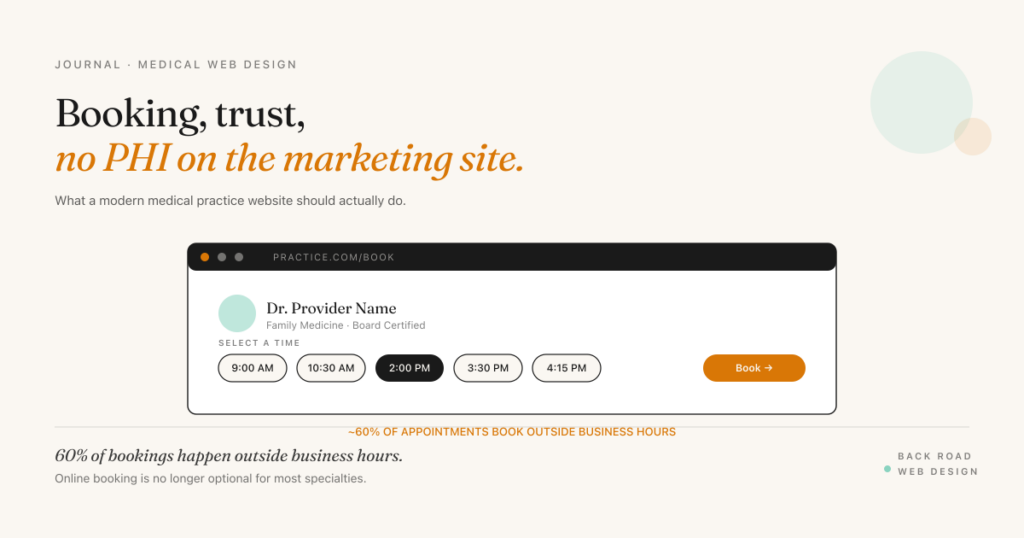
- They want to book outside of business hours. Industry research has cited that nearly 60% of doctor’s appointments are booked outside of office hours. If your site forces a phone call during 9-to-5 hours, you’ve lost the majority of new-patient inquiries to competitors who didn’t.
- They want to see who they’re booking with. Provider photos with substantive bios, with bios that include credentials and specialty focus, dramatically outperform stock photography. Patients want to assess fit before showing up.
- They want certainty about insurance and cost. A page that lists accepted insurance plans clearly, with a contact path for verification, removes the biggest friction point in healthcare buying.
Practice websites that fail at these three either lose new patients to competitors who got the basics right or convert at much lower rates than they could.
The booking model that fits each specialty
Online booking isn’t appropriate for every specialty in the same way. Three integration models cover most practices: SaaS widget embeds, API-connected platforms, and custom-built systems. The right one depends on practice size, EHR integration needs, and patient expectations for the specialty.
Solo and small-group practices: widget embeds
For most solo practitioners and 2-to-3-provider groups, a widget embed from Jane App, SimplePractice, NexHealth, or similar is the right answer. The widget drops onto the website, the patient picks a provider and time, and the booking lands in the practice management system. Setup time is hours, not weeks. Cost is typically $50–$200 a month for the underlying scheduling platform.
The trade-off: limited customization on look-and-feel of the booking widget itself. The site looks unified until the patient clicks “book” and lands on a different-looking interface. For most practices the friction is acceptable; for high-end concierge or aesthetic practices, the visual mismatch can hurt conversion.
Multi-provider, multi-location practices: API integration
For groups with multiple providers and multi-location complexity, the widget often falls short — you need provider-specific availability, appointment-type routing, possibly EHR sync, and intelligent patient routing across locations. This is where API integration with NexHealth, Luma Health, or similar enterprise scheduling platforms makes sense. Cost typically runs $200–$800 per month for the platform plus $2,000–$15,000 for development integration.
The investment usually pays back via reduced no-shows (automated reminders cut no-show rates significantly) and reduced front-desk phone time.
Specialties where direct booking doesn’t fit
Mental health practices, complex specialty consults, and any visit that requires insurance pre-authorization typically work better with appointment request forms rather than direct booking. The patient submits preferred times and a brief reason for the visit; the practice contacts back to confirm or adjust. For mental health specifically, the initial conversation often serves as a fit assessment that direct booking can’t replicate.
The HIPAA reality: keep PHI off the marketing site
The single most important architectural rule for medical practice sites in 2026: keep Protected Health Information off the marketing website entirely. The average cost of a healthcare data breach reached $7.42 million in 2024 — and most breaches happen because PHI is collected on systems not designed to handle it.
The architecture pattern that works:
- Marketing site lives on a standard CMS (WordPress, Squarespace, etc.). It does not collect PHI. Forms only collect non-sensitive contact information — name, phone, email, general reason for inquiry.
- Booking happens on a HIPAA-compliant platform (Jane App, SimplePractice, NexHealth, etc.) — the platform signs a Business Associate Agreement (BAA) and handles PHI securely.
- Patient portal is on the EHR or a HIPAA-compliant portal — accessible via a clearly-labeled login link, but separated from the marketing site infrastructure.
This separation simplifies compliance dramatically. The marketing site is just a marketing site, with the same compliance posture as any website. The HIPAA work is concentrated in the scheduling platform and patient portal, both of which already have BAAs and security controls in place.
What this means specifically: don’t put a “Tell us about your symptoms” field on a contact form. Don’t ask for date of birth on a marketing-site appointment request. Don’t request insurance card photos through a standard contact form. Each of those mistakes turns the marketing site into a PHI repository, which dramatically increases compliance scope.
Trust signals that move conversion
Healthcare is a YMYL (Your Money or Your Life) category — the trust signals matter more than they do in most industries. The ones that consistently move conversion:
- Real provider photos with substantive bios. Stock photography is obvious and reads as evasive. A real headshot, with a bio that names the medical school, residency, board certification, and clinical interests, signals legitimacy.
- Recent Google reviews displayed prominently. Volume matters; recency matters more. Reviews from the last 90 days carry more weight than older ones for both ranking and patient confidence.
- Insurance accepted, listed clearly. A list of accepted plans removes the biggest single friction point. “Contact us to verify” is a much weaker signal than “We accept Anthem, Blue Shield, Aetna, Cigna, Medicare.”
- Office photos. Real photos of the waiting room, the exam rooms, the reception area. Sets expectations and signals that you’ve curated the patient experience.
- Awards, recognitions, hospital affiliations. Particularly relevant for specialists. A logo strip with hospital affiliations or board certifications builds credibility quickly.
What doesn’t move conversion: vague “We provide compassionate care” copy, generic icon grids of services, hero videos of stock-footage stethoscopes. Patients filter past these signals automatically; they’re noise.
Mobile-first is no longer optional
Industry data has cited that 75%+ of patients browse on mobile. Practices that designed their site for desktop and bolted on mobile responsiveness as an afterthought consistently underperform.
Mobile-first specifics that matter:
- Tap-to-call buttons in the header and at every CTA. Patients on mobile who want to call shouldn’t have to copy the number.
- Booking widget that works smoothly on a phone. If the booking flow requires zooming or horizontal scrolling, the patient bails.
- Map and directions that integrate with the phone’s native nav. A static address loses to a “Get Directions” button that opens Apple/Google Maps.
- Page load under 3 seconds on mobile. The medical category has higher patience than e-commerce, but not unlimited. Largest Contentful Paint should hit under 2.5 seconds for “good” per Google’s Core Web Vitals.
Score your medical practice site
Medical Practice Website Audit · 8 Items
Score your practice’s website.
Want a custom audit of your medical practice’s website?
I’ll review your site against the eight items above plus the SEO and conversion specifics for your specialty — then send you a written report with the moves ranked by impact.
Get a free practice website audit →