
Pest Control Marketing on the Central Coast: Aligning Spend to the Calendar
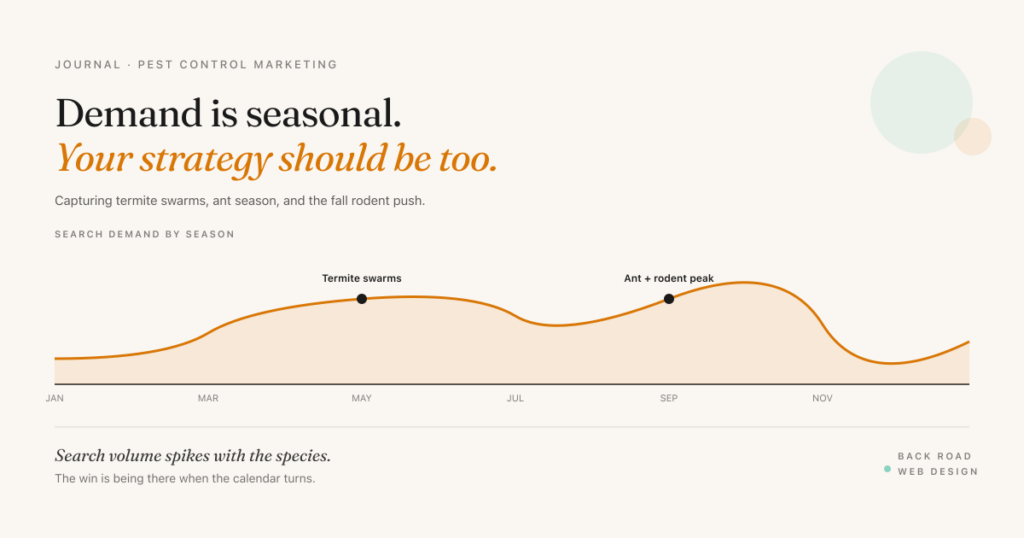
Pest control demand isn’t steady. It spikes when termites swarm in spring, climbs again as ants invade kitchens through summer drought, and peaks once more in early fall when rodents start looking for warm places to nest. Most pest control marketing is built like demand is steady — same Google Ads spend in February as in May, same SEO content for “termite control” running year-round, same generic homepage trying to do all the work. That mismatch is why the marketing budgets feel like they’re working hardest in the months when demand was going to come anyway.
This post walks through the seasonal demand patterns that actually hit Central Coast pest control companies, the trade-off between Google Ads and SEO for catching them, the hyperlocal landing page structure that wins multi-city visibility, and the trust signals that matter most when someone’s letting a stranger into their home.
The seasonal demand reality on the Central Coast
California is unusual because it doesn’t have one termite season — it has many. The state hosts more than 20 termite species, and different species swarm at different times of year. Western subterranean termites swarm during daylight after rain, generally in fall through early spring. Drywood termites swarm in summer and into fall. Pacific dampwood termites swarm in late summer to early fall, around dusk.
What that means for marketing: “termite control” is not a single search peak. It’s multiple peaks scattered through the year, each tied to specific weather conditions and specific species. After the first warm rain of spring, search volume for “termite swarmers” can spike in a single week and stay elevated for ten days, then settle. The companies ready for that spike — with current ads, fresh blog content from the last two weeks, and a Google Business Profile post mentioning the swarm — capture the calls. The ones running a generic January campaign in May miss it.
The other peaks follow the same pattern with different triggers:
- Spring (March–May): Subterranean termite swarms after rain. Carpenter ant activity begins. Wasp and yellow jacket nest building.
- Summer (June–August): Ant invasions driven by drought — colonies move indoors looking for water. Cockroach activity climbs in warm areas. Drywood termite swarms begin.
- Fall (September–November): Rodents start seeking indoor shelter as nights cool. Drywood termite swarms peak in September. Spiders move indoors. Industry surveys have found that California pest professionals consistently report rodent service calls climb sharply in cooler months.
- Winter (December–February): Rodent activity continues. Western subterranean termite swarms occur on warm winter days after rain. Demand is overall lowest, but specific spikes still happen.
The Central Coast specifically — coastal SLO and Santa Barbara counties — sees somewhat softer summer drought pressure than inland California, which means ant pressure is more spread out. But the spring termite swarm and fall rodent push are still the two largest seasonal peaks for most pest control companies in the region.
Google Ads vs. SEO — and when each one wins
Both channels matter for pest control. They do different jobs.
Google Ads is the seasonal capture tool
When a homeowner sees swarming termites and Googles “termite swarmers in my house,” they’re not in the mood to read a blog post. They want a phone number and the next available appointment. Google Ads, with location extensions and call tracking, captures that intent at the exact moment it spikes. The ad shows up first, the click goes to a focused landing page, and the call arrives within minutes.
The seasonal play with ads: schedule budget increases to coincide with the peaks. A pest control company that runs $1,500 a month flat across the year is paying full premium-CPC rates in May (when CPCs spike with demand) and overpaying for low-converting traffic in February. The same $18,000 annual budget reallocated — heavier in March-May and August-October, lighter in December-February — produces meaningfully more leads from the same total spend.
SEO is the long compounding tool
SEO can’t catch a sudden swarm — by the time content ranks, the swarm has passed. What SEO does is capture the steady search volume that flows through every season. “Pest control [city]” gets searched every month of the year. So does “ant exterminator,” “rodent removal,” and dozens of other base service terms. A site that ranks well for those terms gets calls weekly without paying per click.
The SEO play for pest control: a service-and-location matrix similar to the one outlined for general home services contractors. One page per major service (termite, ant, rodent, etc.) and one page per major service area (Atascadero, Paso Robles, Santa Maria, Lompoc, etc.), with the higher-volume combinations getting their own dedicated service-in-city pages. The infrastructure compounds for years.
Hyperlocal landing pages that earn the call
The mistake most pest control sites make is treating “service area” as a single bullet list on the homepage. Real city pages are what rank in cities outside your home base.
What goes on a pest control city page that pulls its weight:
- Local pest pressure context. Real information about the pest issues common to that specific city. Coastal towns like Cambria deal with different species and pressures than inland Paso Robles. Atascadero sees more rodent activity due to its rural-residential mix; downtown SLO sees more apartment-driven roach calls. Generic “we treat ants and termites” copy doesn’t carry this signal — local context does.
- Specific neighborhoods or developments you’ve serviced. Naming actual neighborhoods (“we’ve done termite work in Edna Valley homes built in the 1970s, where the foundation specifics make subterranean infestations especially common”) signals real ground knowledge.
- Reviews from customers in that specific city, displayed on the page. A Paso Robles reviewer’s comments on the Paso Robles page is a stronger relevance signal than the same review on a generic testimonials page.
- Pricing transparency, even rough. Most pest control sites bury pricing entirely. A page that says “termite inspections in Atascadero typically run $X to $Y depending on home size” is more useful, more trusted, and ranks better than one that demands a phone call to learn anything.
- A clear, single primary CTA. Either “Schedule a free inspection” or “Call us for same-day service” — not both, not five. Pages with a single dominant action convert better than pages with five competing options.
Trust signals matter more for pest control than for most home services
Hiring a pest control company involves letting a stranger into the home, often into bedrooms, kitchens, attics, and crawl spaces. Many calls come from anxious homeowners who’ve just seen something disturbing — swarming termites, rat droppings, a roach in the kitchen. The marketing has to do unusual emotional work: project competence, calm, and trustworthiness all at once.
The signals that move the needle:
- Recent reviews on Google Business Profile. Volume matters; recency matters more. Reviews from the last 90 days carry more weight than older ones for both ranking and customer confidence. The full reviews playbook covers the system to generate them consistently.
- Photos of the actual technicians and trucks. Stock imagery is obvious and feels evasive. Real photos of real staff in branded shirts, real trucks, real equipment, build the “this is a real local company” signal that high-anxiety customers need.
- Licenses and certifications visible on the homepage. California pest control operators must hold a Structural Pest Control Board license. Displaying the license number prominently signals legitimacy. Industry certifications (Quality Pro, GreenPro) add depth.
- An honest “what to expect” page. Most homeowners have never hired pest control before. A page that walks through what a typical inspection looks like, how long it takes, what the technician will do, what the home needs to be prepared for — removes friction for the anxious first-time caller.
Aligning marketing to the calendar
The practical version of seasonal marketing for a Central Coast pest control company:
- February–March: Refresh termite content. Publish blog posts about subterranean termite swarms and what homeowners should look for. Increase ad budget for termite-related keywords starting around the first significant rain. Send an email to past customers with a “spring inspection” offer.
- May–June: Pivot to ant-related content and ads. Many homeowners have never thought about pest control until ants invade the kitchen — capture that moment. Push reviews from recent ant treatments to demonstrate competence in the relevant service.
- August–September: Lean into rodent prep content. “Get ahead of fall rodent season” content published in August catches the homeowners who plan ahead. Increase ad budgets for rodent terms starting in September.
- November–December: Lower paid spend, focus on annual contract sales for the next year, and use the slow season to publish foundational SEO content — service pages, city pages, FAQ content — that compounds in the next year’s peaks.
None of this requires a bigger budget. It requires sequencing the same budget against the calendar.
Score your pest control marketing readiness
Pest Control Marketing Audit · 8 Items
Score your seasonal readiness.
Want help building seasonal pest control marketing?
I’ll review your current website, ad spend timing, Google Business Profile, and review system — then send you a written report with the specific moves ranked by impact for the upcoming pest season.
Get a free pest control marketing audit →