
Tree Service SEO on the Central Coast: How to Rank for Removal, Pruning, and Emergency Work
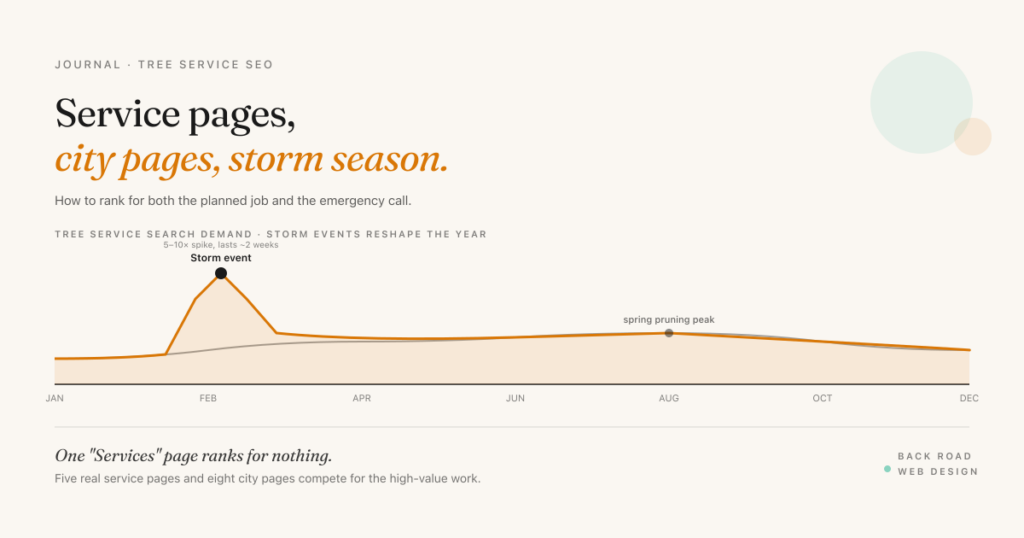
Tree service is one of the more competitive home services categories on the Central Coast, partly because demand is uneven (storm seasons spike everything; summers are quieter), partly because customer acquisition costs through paid channels are high, and partly because most tree service websites are built off the same template — a hero photo of a chainsaw, a list of services with no detail, a contact form, a phone number. Three out of four tree service sites in San Luis Obispo and Santa Barbara counties look interchangeable.
This post walks through what tree service SEO actually looks like in 2026 — the keyword categories that drive booked jobs vs. tire-kickers, the service-specific page structure that earns rankings, the storm-season demand pattern, and the trust signals that move conversion in a category where customers worry about safety and liability.
Why tree service SEO is its own category
Tree service searches behave differently from most home-services searches. A few specific patterns:
- Demand is dramatically seasonal and event-driven. A windstorm or fire season can spike “emergency tree removal” searches 5-10x in a week. The sites that rank well during the spike capture jobs that wouldn’t have come otherwise. The sites that rank well only in normal months miss the high-margin emergency work.
- Customers worry about safety and liability. Unlike a plumber or electrician where the worst case is a leak, a tree service mistake can drop a 60-foot oak through the roof. Trust signals — licensing, ISA certification, insurance — matter more than they do in most home-services categories.
- The job-value range is enormous. A small trim might be $300; a full removal of three large oaks might be $8,000. The marketing has to attract both, but the sites that consistently win the high-value end have specific moves the sites that win the low-value end don’t.
- Local Service Ads are a major channel. Google’s LSA program (the badge-marked listings at the very top of the SERP) is significant for tree service. Ranking in LSA requires Google Guarantee verification but produces high-intent leads with priced-by-lead billing.
SEO for tree service is the long-term complement to LSA — the channel that produces leads without per-lead cost and that compounds over years.
The keyword categories that book jobs
Tree service keywords split cleanly into commercial and informational categories. Commercial keywords come from people ready to hire — “tree removal near me,” “arborist in [city],” “emergency tree service” — while informational keywords come from people looking for advice — “why are my tree leaves turning brown,” “how to tell if a tree is dying”.
The commercial categories that matter most for Central Coast tree services:
- “[Service] near me” / “[Service] in [city]” — “tree removal near me,” “tree service San Luis Obispo,” “arborist Paso Robles,” “stump grinding Santa Maria.” High-intent, location-specific. The biggest single source of bookable leads.
- “Emergency tree service” / “fallen tree removal” — Spikes during storms. Lower volume in calm weather, much higher volume after wind events. Worth ranking for year-round.
- Service-specific searches — “tree pruning [city],” “stump grinding cost,” “palm tree trimming.” More specific than “tree service,” which means lower volume but higher conversion intent.
- Tree-species-specific searches — “oak tree pruning,” “eucalyptus removal cost,” “pine tree disease.” Narrower volume but very high intent — someone Googling “eucalyptus removal” is past the “do I need a tree service” question.
Informational searches are useful but should be treated as content marketing, not as primary lead drivers. A blog post answering “why are my tree leaves turning brown” generates traffic but not many bookings unless it’s specifically engineered to funnel to a service page with a strong CTA.
Service-specific pages: the structural requirement
The single biggest structural difference between tree service sites that rank and ones that don’t: separate pages for each major service. Not one “Services” page with a list. Real pages, with substantive content, for each of:
- Tree removal — including process, pricing factors, when removal is necessary vs. avoidable, what the cleanup includes.
- Stump grinding — different from tree removal, often a separate price quote, frequently searched independently.
- Tree pruning — including seasonal timing, ISA-certified arborist guidance, the difference between pruning and topping.
- Emergency tree service — 24/7 availability, response time, fallen-tree-on-house specifics.
- Tree health and assessment — for customers who aren’t sure whether they need removal vs. treatment.
Each of these pages can rank for its specific search intent. A single combined page is mid-rank for everything and dominant for nothing. An example like Brown Tree’s structure with seven separate service pages, including emergency services, demonstrates the pattern that works.
Service-area pages for the Central Coast
For a tree service operating across SLO and Santa Barbara counties, a single homepage saying “we serve the Central Coast” doesn’t compete for city-specific searches. The page structure that works is the same one I covered in the home-services service area SEO playbook — separate, substantive city pages for each major service area.
For a typical Central Coast tree service, that’s:
- San Luis Obispo
- Paso Robles
- Atascadero
- Arroyo Grande
- Pismo Beach
- Santa Maria
- Santa Barbara
- Goleta
Each city page should have unique content, real photos of work done in that city when possible, and city-specific schema markup with areaServed. Generic templated city pages with the city name swapped out are easy to detect and Google often devalues them.
The trust signals that move conversion
Tree service customers are evaluating risk more than most home-services categories. The trust signals that consistently move conversion:
- ISA certification. The International Society of Arboriculture is the industry credential. Listing on industry directories like ISA and the Tree Care Industry Association also signals professionalism to Google’s algorithms.
- Insurance and licensing prominently displayed. California contractor’s license number, general liability insurance, workers’ comp. These should be visible on the homepage and on every service page.
- Before-and-after photos of real work. Stock photography of trees fails. Photos of jobs done — same camera angle, before and after — are dramatically more persuasive.
- Recent Google reviews. The 4.8-stars-with-200-reviews threshold is what most customers consider table-stakes for a tree service.
- Equipment photos. Pictures of the actual trucks, chippers, and rigging gear. Especially relevant for big-job customers — they want to know you have the equipment to handle their oak.
What doesn’t move conversion: stock photos of generic chainsaws, “We’re family-owned and operated” tagline copy, vague “fully insured” language without specifics. These are filtered as noise.
Local Service Ads as the SEO complement
Google’s Local Service Ads (LSA) program is a paid channel that often takes the top of the SERP for tree service searches in California. Worth understanding because it interacts with SEO:
- LSA requires Google Guarantee verification (background check, license verification, insurance verification).
- LSA bids per-lead, not per-click. Typical California tree service lead cost runs $40–$120.
- LSA ranking depends partly on review velocity. Tree service companies consistently generating new reviews tend to get more LSA leads at lower costs than ones with higher LSA budgets but stagnant review velocity.
- LSA does not replace SEO. The organic results below LSA still get significant clicks, and many customers scroll past LSA to compare.
The right play for most Central Coast tree services is to run LSA and SEO together — LSA captures immediate-need searches at predictable cost; SEO compounds visibility for both immediate-need and research-stage searches without per-lead cost.
Score your tree service site
Tree Service SEO · 8 Items
Score your tree service site.
Want a custom audit of your tree service site?
I’ll review your service pages, city pages, GBP, schema, and conversion tracking — then send you a written report with the moves ranked by impact for your service area.
Get a free tree service SEO audit →