
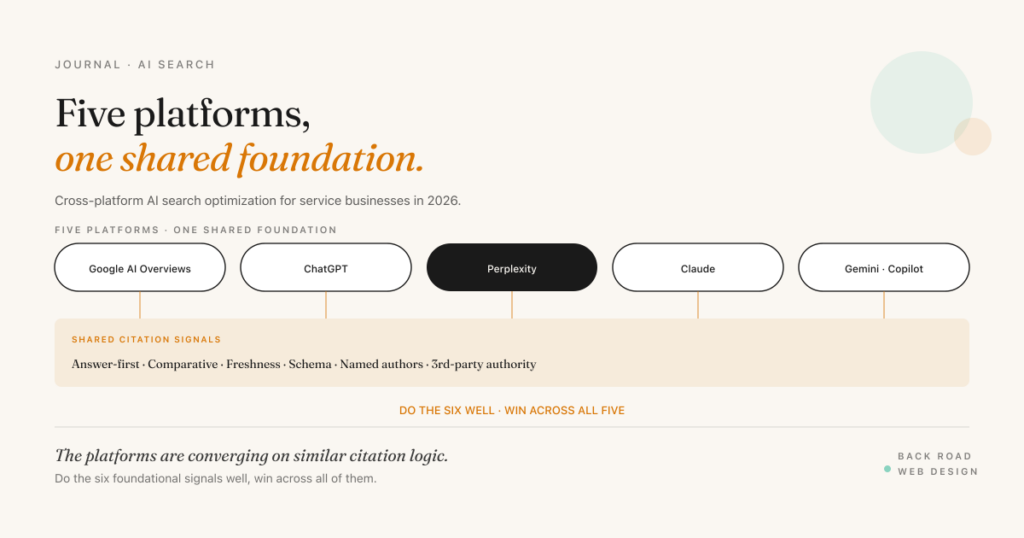
2026 is the year traditional SEO and AI search optimization stopped being separate disciplines. The signals that determine whether your content ranks on Google now substantially overlap with the signals that determine whether you get cited by ChatGPT, Perplexity, Claude, Gemini, and Copilot. Different platforms still weight things differently — Perplexity rewards freshness more than Google does, ChatGPT weights training-data brand mentions Perplexity ignores — but the core work has converged.
This post walks through the unified AI search landscape as it actually exists right now: which platforms matter most, how their citation logic differs, the cross-platform signals that win the most often, and the realistic prioritization for a service business that can’t optimize for everything at once.
The five platforms and how they behave
Google AI Overviews
The biggest by volume — AI Overviews now appear on a substantial share of all Google queries, including a meaningful percentage of local intent queries. Industry research has cited that approximately 92.36% of AI Overview citations come from domains ranking in Google’s top 10 organic results — meaning traditional SEO is still the prerequisite for AI Overview inclusion. Optimization here is incremental on top of strong SEO foundations.
What’s distinctive: AI Overview citation responds quickly to content updates (Google AI Overviews pull from a continuously refreshed index). Updating an existing strong-ranking page with cleaner answer-first structure can produce AI Overview citations within weeks.
ChatGPT
The second-biggest by volume. Two distinct citation paths — training data (slow to influence) and live retrieval (responsive to content updates). For most professional service queries, live retrieval is the bigger near-term lever. ChatGPT doesn’t reliably send referral traffic, so measurement requires direct query testing rather than analytics. Covered in depth in the ChatGPT SEO playbook.
Perplexity
Smaller user base than ChatGPT but a higher-quality user mix — research-oriented, technical, and high-income skew. Visitors arriving from AI citations have been observed to convert at substantially higher rates than typical Google organic visitors. Perplexity sends measurable referral traffic, making it the most trackable AI search channel. Covered in depth in the Perplexity SEO playbook.
Claude
Anthropic’s Claude has a smaller user base than ChatGPT but punches above its weight in professional and developer use cases. Citation behavior is broadly similar to ChatGPT — favoring authoritative sources, structured content, and entity-clear references. For most local service businesses, optimizing specifically for Claude isn’t necessary; the work that wins ChatGPT also wins Claude.
Gemini and Copilot
Google Gemini draws on similar source signals to AI Overviews — heavy weight on Google’s index, top-10 ranking as a near-prerequisite. Microsoft Copilot draws from Bing’s index and weights different sources — particularly LinkedIn (Microsoft owns it) and Reddit. For service businesses with B2B audiences, Copilot visibility is worth a separate look.
The cross-platform signals that consistently win
Six signals show up in every credible analysis of what produces AI citations across platforms. None of them is novel, but the priority order has shifted compared to traditional SEO:
- Answer-first content structure. Concrete claims in the first 5–10 lines under each heading. Definitive language (“X costs $Y in [city]”) rather than hedged language. Specific numbers, dates, names.
- Comparative formatting. “Five things to look for,” “Three ways to choose,” “X vs Y” content. A TryProfound analysis of approximately 177 million AI citations found comparative listicles account for roughly 32.5% of all citations — more than triple the second-most-cited format.
- Content freshness. Substantive updates within the last 30–90 days. Date-stamp manipulation doesn’t help; real content updates do. An Ahrefs analysis of 17 million AI citations found AI-cited content is approximately 25.7% fresher than the typical Google-ranked organic result.
- Schema markup completeness. LocalBusiness, Service, FAQPage, Article — each schema gives the AI a different extractable signal. Together they materially increase citation probability.
- Named authors with credentials. Anonymous content gets cited at much lower rates. Linked author bios with verifiable expertise build the trust signal AI engines explicitly weight.
- Third-party authority signals. Mentions on Reddit, Yelp, industry directories, local “best of” articles. AI engines synthesize across the web; brand presence beyond your own domain matters as much as content on your own domain.
If you do these six well, you don’t need to optimize separately for each platform. The cross-platform foundation does the work.
The portfolio approach to AI search
Different platforms reach different audiences. The realistic prioritization for a service business looks something like:
- Google AI Overviews — high priority. Largest volume, cleanest measurement (via Search Console), most overlap with existing SEO investment. Work here pays back fastest.
- Perplexity — high priority for B2B and research-driven categories. Highest-quality user mix, sends measurable referral traffic, citation work compounds quickly because the field is less competitive.
- ChatGPT — medium priority. Big volume but tracking is hard, and most signals overlap with Google AI Overviews work. Worth direct testing monthly but rarely worth a dedicated optimization track.
- Claude — low priority. Optimize for ChatGPT and Perplexity; Claude rides along.
- Gemini and Copilot — low priority for most local service businesses, medium for B2B. Microsoft’s Bing index and LinkedIn weighting matter more for B2B than for local consumer-facing services.
This isn’t “ignore the others” — it’s “do the foundational cross-platform work first, then layer on platform-specific work for the highest-priority targets.”
What changes for local service businesses specifically
The local service business case has a few specific patterns:
- Local pack still matters but matters less than it did. Google Business Profile is still essential — it’s both a direct lead source and a signal to AI engines about your business. But the local pack now sits below AI Overviews when both appear.
- Reviews matter for both star ratings AND text content. AI engines extract specific service mentions and outcomes from review text. Coaching customers (not scripting them) toward reviews that mention specific services and locations produces compounding visibility.
- Service-specific and city-specific pages matter more than ever. AI engines decompose complex queries into sub-queries. More dedicated pages = more chances to be cited.
- Third-party listings carry more weight in AI than they did in Google’s local algorithm. Yelp, Thumbtack, Houzz, industry directories, BBB — these aren’t just citations for traditional local SEO purposes anymore. They’re substantive content sources that AI engines extract from.
What’s likely changing through 2026
A few patterns to watch as the year unfolds:
- AI Overview coverage will keep expanding into more local intent queries. If your category currently doesn’t trigger AI Overviews, it probably will within a few months.
- Tracking will get better. Profound, Otterly, BrightEdge, Ahrefs, and others are racing to expose AI citation data. Worth budgeting for one of these tools by mid-2026 if you’re serious about this work.
- The freshness premium will compound. Content updated within 30 days now meaningfully outperforms older content; this gap will widen as AI engines get more confident in real-time retrieval.
- AI shopping experiences will reshape transactional queries. ChatGPT shopping, Perplexity Pages, Google’s product-discovery experiments. Less directly relevant for service businesses, but worth watching.
Score your AI search readiness
AI Search Optimization · 8 Items
Score your cross-platform AI readiness.
Want a custom audit of your AI search readiness?
I’ll test your buyer queries across Google AI Overviews, ChatGPT, and Perplexity, document your visibility on each platform, and send you a written report with the moves ranked by cross-platform impact.
Get a free AI search audit →