
Every conversation I’ve had with a service business owner over the last six months ends up at some version of the same question: “Should I be doing something different now that everyone’s using ChatGPT?” The honest answer is yes, but probably not in the dramatic way the AI industry is selling it. AI SEO for a local service business isn’t a separate channel that replaces traditional SEO — it’s a layer of structural changes that rides on top of strong fundamentals and compounds the work you’re already doing.
This post is the cluster anchor for the AI SEO content I’ve been publishing. It walks through what AI SEO means for service businesses, where the existing AI search landscape stands as of mid-2026, and a realistic prioritization framework — what to do first, what to do later, and what to skip entirely.
What AI SEO means in 2026
“AI SEO” is one of those phrases that means different things depending on who’s selling. The version that matters for service businesses is specific:
- It is the practice of optimizing your digital presence so AI engines (Google AI Overviews, ChatGPT, Perplexity, Claude, Gemini, Copilot) can extract, cite, and recommend your business when buyers ask category questions.
- It is not using AI tools to generate SEO content faster — that’s content production, which is fine but separate.
- It is mostly traditional SEO done with attention to specific structural patterns that AI engines reward.
- It is not a magic bullet, a separate channel, or something that replaces ranking on Google. AI Overview citations heavily favor pages that already rank in Google’s top 10.
The economic case for paying attention is straightforward. AI Overviews now appear on a meaningful share of local intent queries. When they do, organic CTR drops substantially — but brands cited inside the AI Overview earn more clicks than they would have without it. The center of gravity for visibility has moved from “rank position” to “citation inclusion.”
The hierarchy that matters
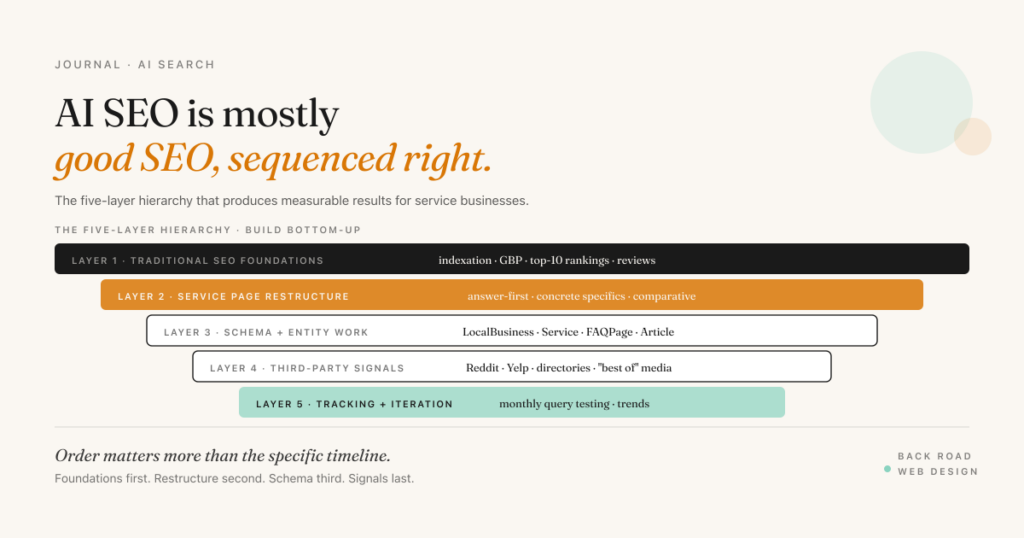
The biggest mistake I see service businesses making with AI SEO is starting at the wrong layer. Here’s the priority order that produces results:
Layer 1 — Traditional SEO foundations (prerequisite)
Before any AI optimization makes sense, the basics need to be working: your site indexes cleanly, your pages rank for at least some of your target queries, your Google Business Profile is fully populated and active, your reviews are actively being requested. Without these, AI optimization is decoration on a foundation that isn’t holding up. Roughly 92% of AI Overview citations come from domains in Google’s top 10. If you’re not ranking, you’re not citation candidates.
Layer 2 — Service page restructure
Once foundations are in place, the highest-leverage change is restructuring your top three to five service pages for AI extraction:
Most service-business sites can complete this layer in a focused two-week sprint. The lift is meaningful and shows up across all five major AI platforms because they share extraction logic.
Layer 3 — Schema and entity work
LocalBusiness schema with full NAP, hours, geo, and accepted payment methods. Service schema for each individual offering with price ranges. FAQPage schema with real buyer questions. Article schema on resource pages. Each schema gives AI engines a different extractable signal. This is mostly a one-time setup with periodic updates.
Layer 4 — Third-party signal building
The slowest layer to build but the longest-compounding. About 60% of local AI Overview citations go to third-party publishers — Yelp, Thumbtack, HomeGuide, Reddit, Quora, industry-specific directories. The ongoing work here is:
- Pitching for inclusion in local “best of” articles.
- Maintaining substantive review content on Yelp, Google, and category-specific platforms.
- Industry directory presence (Healthgrades for medical, Avvo for legal, Houzz for contractors, etc.).
- Reddit and community participation where genuine expertise is welcome.
- Earned media in local outlets.
Layer 5 — Tracking and iteration
AI search measurement is messier than traditional SEO measurement. The realistic stack: monthly direct testing across Google AI Overviews, ChatGPT, and Perplexity for your top buyer queries, GA4 monitoring of Perplexity referral traffic (it sends measurable referrals), and brand mention tracking via Profound, Otterly, Ahrefs, or BrightEdge for businesses serious enough about this to budget a tool. Document monthly. The trend matters more than any individual result.
What a realistic six-month plan looks like
- Month 1 — Foundations audit and quick wins. Verify SEO fundamentals (indexation, GBP, top-10 rankings on key queries). Restructure homepage and top three service pages for answer-first content. Add or upgrade LocalBusiness, Service, FAQPage schema.
- Month 2 — Baseline AI testing. Document current AI search visibility across Google AI Overviews, ChatGPT, and Perplexity for 10 buyer queries. Add named author bios. Begin a review-quality program.
- Month 3 — Topical depth. Add or strengthen service-specific pages and city-specific service area pages. Each one structured for AI extraction. Begin pitching for “best of” inclusion.
- Month 4 — Third-party signals. Build out industry-specific directory presence. Identify two relevant Reddit communities and start participating helpfully. Refresh existing high-traffic content for AI freshness signals.
- Month 5 — Re-test and iterate. Re-run the AI testing from month 2. Document changes. Identify queries where the work is showing up and queries where it isn’t. Iterate on the underperforming queries.
- Month 6 — Measurement maturity. If the work is producing results, layer in a tracking tool (Profound, Otterly). Set quarterly review cadence. Begin treating AI search as ongoing infrastructure rather than a project.
This is paced for a service business that can dedicate a few hours per week to the work. Larger businesses can compress this; smaller ones can extend it. The order matters more than the specific timeline.
What to skip
A few things being marketed as “AI SEO” that don’t deserve a service business’s time and budget right now:
- Mass AI-generated content. AI engines actively filter low-quality AI-generated content. Volume strategies don’t work and often hurt.
- Tools that promise to “submit your site to AI search engines.” AI engines don’t accept submissions. The work is structural, not transactional.
- Schema-only strategies that ignore content quality. Schema is a multiplier on good content, not a substitute for it.
- Heavy investment in AI platforms with little user overlap with your audience. Optimizing for Claude when your audience uses Google AI Overviews is misallocated effort.
- Trying to “block” AI crawlers. The only effect is removing yourself from AI visibility entirely, which usually isn’t what businesses actually want.
Score your AI SEO foundation
AI SEO Foundation · 8 Items
Score your AI SEO foundation.
Want a custom audit of your AI SEO foundation?
I’ll review your site against the AI search landscape, document where you’re cited and where you’re not, and send you a written report with the moves ranked by impact and sequenced for a realistic timeline.
Get a free AI SEO audit →