
Santa Ynez Valley has more than 100 wineries spread across six small towns and four sub-AVAs. For a wine buyer Googling “Solvang wine tasting” or “Sta. Rita Hills Pinot Noir,” the local pack and organic results are the gateway to your tasting room — not Yelp, not Instagram, not any travel publication. Most Santa Ynez Valley winery websites are built like brochures from 2014: a homepage, an “about us,” a wine list, a blank contact form. They rank for nothing competitive. They convert nothing well.
This post walks through what Santa Ynez Valley winery SEO actually looks like in 2026 — the AVA structure that matters, the hyperlocal town pages that earn rankings, the Pinot/Chardonnay/Rhône-specific keyword strategy, and the on-page changes that make a winery site work for both search engines and the wine traveler planning a weekend.
The AVA reality
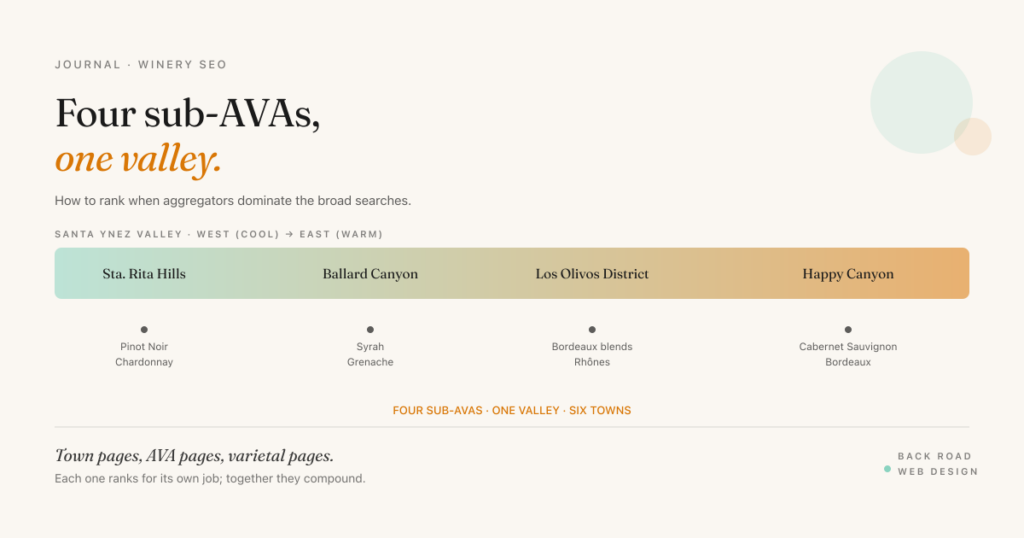
Santa Barbara County contains about 21,000 acres of vineyards spread across seven American Viticultural Areas. The Santa Ynez Valley AVA itself contains four sub-appellations: Sta. Rita Hills on its western boundary, Ballard Canyon and Los Olivos District in the center, and Happy Canyon on the east. Each one has different climate, soil, and varietal specialization:
- Sta. Rita Hills (cool, marine-influenced) — Pinot Noir and Chardonnay dominate. The classic Sideways territory.
- Ballard Canyon (warmer, calcareous soils) — Rhône varieties: Syrah, Grenache, Viognier.
- Los Olivos District (warm, flatter) — Bordeaux and Rhône blends, some Spanish and Italian varieties.
- Happy Canyon (warmest, on the eastern edge) — Cabernet Sauvignon and Bordeaux blends.
If your tasting room is in Solvang but your estate vineyard is in Sta. Rita Hills, that’s two different sets of geographic and topical signals you need to send. Most winery sites send neither cleanly — they list “Santa Barbara County” once on the homepage and never again.
The keyword categories that matter
Santa Ynez Valley winery searches fall into four main groups. Each one needs its own page or page section.
1. Town-based searches
“Solvang wineries,” “Los Olivos tasting rooms,” “Buellton wine tasting.” These are dominated by aggregator sites — Visit Solvang, Wine Enthusiast, travel blogs. As a single winery, you won’t rank #1 for “Solvang wineries” because Google rightly serves the user a list. But you can absolutely rank for “[your winery] Solvang” and adjacent searches like “Solvang Pinot Noir tasting” or “best Sta. Rita Hills tasting room in Solvang” with the right content.
The page that captures these is your tasting-room location page. Not the homepage — a dedicated page that explicitly says “tasting room in [town],” includes the address, hours, what experiences you offer, and what makes the space distinctive. If you have multiple tasting rooms (like Fess Parker, with locations in Los Olivos and the Funk Zone), each one needs its own page.
2. AVA-based searches
“Sta. Rita Hills Pinot Noir,” “Ballard Canyon Syrah,” “Happy Canyon Cabernet.” These are higher-intent searches — someone Googling “Sta. Rita Hills Pinot” knows exactly what they want and is shopping for a producer. The aggregators are weaker here; this is where small wineries can win.
The page is a varietal-and-AVA page. “Our Sta. Rita Hills Pinot Noir program,” with real content about the vineyard sites, the climate, why your approach to that AVA is distinctive, and the specific bottles. Generic “we make great wine” copy won’t compete with Wine Enthusiast’s editorial coverage. Specific, knowledgeable, terroir-driven copy can.
3. Experience-based searches
“Wine tasting in Santa Ynez Valley,” “best winery experience Solvang,” “private tasting Los Olivos.” These map to your reservations, experiences, and tasting menu pages. The keyword volume here is solid and the intent is high — someone making a reservation is already pre-sold on visiting.
Wineries that integrate with reservation platforms like CellarPass and Tock get an SEO benefit (the platform’s domain authority) but can’t rely on it alone. The on-site experience pages need to rank in their own right with full descriptions, pricing, photos, and clear booking paths.
4. Wine-club and direct-sales searches
“Santa Barbara wine club,” “Sta. Rita Hills wine subscription,” “[varietal] club California.” Wine club has become one of the largest DTC channels for many wineries in recent years. Your wine club page needs to rank for these searches the same way an e-commerce category page ranks for product searches — with clear descriptions, pricing, member benefits, and easy signup.
What competitors are doing well (and badly)
A few patterns worth noting after auditing several Santa Ynez Valley winery websites:
- The strongest sites have an AVA-explainer page. A page like “About Sta. Rita Hills” or “What makes Ballard Canyon different” earns rankings for educational searches and feeds traffic into the wine pages. Wineries that ignore the AVA story leave that traffic to Wikipedia and Wine Enthusiast.
- Most sites have weak meta descriptions on wine product pages. The default meta description Squarespace or Shopify generates is usually “[Wine name] – [Winery name].” That’s not competitive copy. A strong meta description includes the varietal, the AVA, the vintage, and a pour of personality.
- Photo galleries dominate, content lags. Beautiful photography is necessary but not sufficient. Google can’t rank a beautiful photo without text context. The wineries that combine strong visuals with substantive AVA-specific writing rank substantially better.
- Schema markup is rare. Most Santa Ynez Valley winery sites have no LocalBusiness schema, no FAQ schema, no product schema for the wine list. Implementing these three schemas alone often produces measurable ranking improvements within 60 days.
The town-and-AVA matrix
If your winery has a tasting room in Solvang and an estate vineyard in Sta. Rita Hills, you have two location stories to tell — the visitor experience in Solvang and the winemaking story in Sta. Rita Hills. These are two separate pages, not one combined page.
The structure for a multi-AVA winery typically looks like:
- Location pages: /visit/solvang/, /visit/los-olivos/ — for tasting rooms.
- AVA pages: /vineyards/sta-rita-hills/, /vineyards/ballard-canyon/ — for terroir and winemaking.
- Wine pages: /wines/pinot-noir/, /wines/syrah/ — for the bottles, with internal links to the relevant AVA pages.
- Experience pages: /experiences/private-tasting/, /experiences/vineyard-tour/ — for reservations.
- Club pages: /wine-club/ with sub-pages for different tiers if applicable.
This separation lets each page rank for its specific intent without diluting the others. A single combined page covering all of the above is mid-rank for everything and dominant for nothing.
Local pack and Google Business Profile
The Google Business Profile for the tasting room is its own SEO project. Wineries should be doing all of these:
- Categories set correctly — primary “Winery” or “Tasting Room,” secondary categories for “Wine Tour Operator” if relevant. This is the single biggest local-pack ranking factor.
- Service area disabled if you have a public tasting room — this is a destination business, not a service-area business.
- Photos updated quarterly — both interior and exterior. Google rewards profiles with active recent photos.
- Posts published weekly — release announcements, events, weekday tasting notes. This is one of the most under-used GBP features.
- Reviews actively requested — covered in the reviews playbook. The 10-review threshold matters; the 50-review threshold matters more.
- Q&A section seeded with common questions (“Do you take walk-ins?” “Is parking available?” “What’s the largest group you can accommodate?”). Owner-published Q&A counts as content.
Content the search algorithm rewards
The blog content that pulls weight for Santa Ynez Valley wineries isn’t generic wine content. It’s hyperlocal, hyperseasonal, and tied to specific AVAs and varietals. Examples that work:
- “What 2024 vintage looks like in Sta. Rita Hills” — published just after harvest, ranks for vintage-specific searches months later.
- “How to spend a wine country weekend in Solvang” — competes with travel sites but written from a winemaker’s perspective.
- “What separates Ballard Canyon Syrah from Sta. Rita Hills Syrah” — terroir explainer, ranks for educational searches, feeds traffic into your wine pages.
- “Best months to visit Santa Ynez Valley” — captures planning-stage traffic before competitors do.
- “What harvest looks like at our estate” — seasonal content tied to a specific time, ranks well in late summer and early fall.
Generic content like “What is Pinot Noir” doesn’t rank for Santa Ynez Valley wineries — Wikipedia and major wine publications dominate that space. Hyperlocal content that only your winery could plausibly write is where the ranking gains live.
Score your winery’s SEO readiness
Santa Ynez Valley Winery SEO · 8 Items
Score your winery’s SEO.
Want a custom audit of your Santa Ynez Valley winery’s SEO?
I’ll review your site structure, AVA pages, Google Business Profile, and reservation integrations — then send you a written report with the specific moves ranked by impact.
Get a free winery SEO audit →