
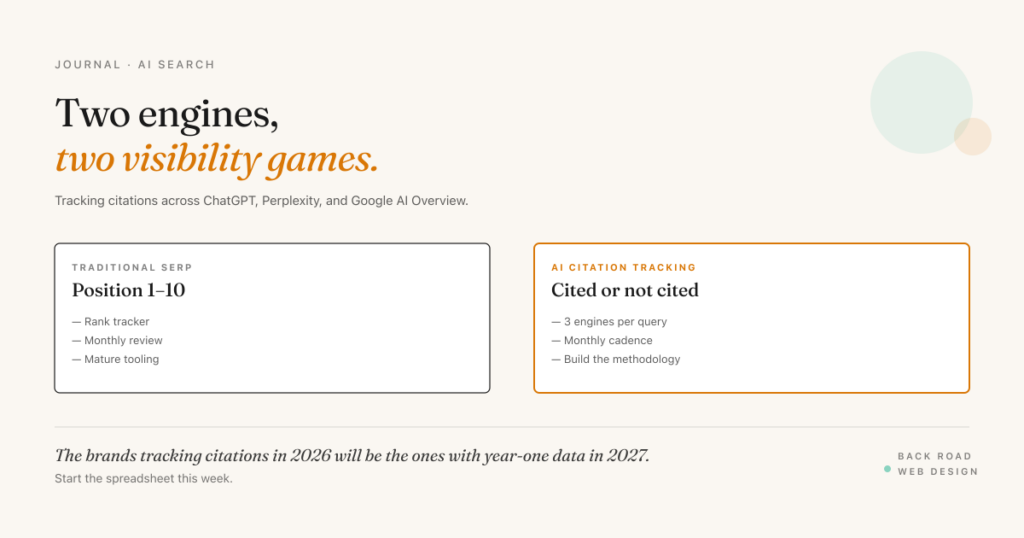
Rank tracking for Google searches is a mature discipline. There’s a spreadsheet template for it, half a dozen good tools that automate it, and most marketing operators have a rhythm for reviewing positions monthly.
AI search citation tracking isn’t there yet. The tooling is early, the methodology is still being figured out in real time, and most operators either ignore it entirely or check it sporadically when they remember. That’s a problem because AI-driven search now drives a meaningful slice of brand discovery — Pew Research found 34% of U.S. adults had used ChatGPT as of mid-2025, roughly double the 2023 share, and adoption has kept climbing.
I built a monthly process to track AI search citations that fits into the same time slot as a traditional rank-tracker review. Here’s the full method.
What “citation tracking” means in AI search
A SERP rank is binary in spirit — you’re either in the top 10, top 3, or you’re not. AI citation is different. The AI engine either references your domain (as a source link, a quote, a brand name in the answer) or it doesn’t. There’s no equivalent of “position 4 versus position 8” — there’s mentioned or not mentioned.
What that means for tracking: you’re not measuring a position number, you’re measuring presence-and-absence across a defined set of queries. The query list is the strategy.
I track three engines monthly: ChatGPT, Perplexity, and Google AI Overview. Each engine generates answers differently and pulls from different source sets, so a brand cited in one might not be cited in the others — and that gap is the work.
The query list
For a business, I track three types of queries per engine:
1. Brand queries. “What is {business name}?” / “Tell me about {business name}.” If the AI engine can’t summarize the business correctly, the foundational entity data is weak — that’s a knowledge-graph and structured-data problem, not a content problem.
2. Category queries. “{Service} in {city}” / “Best {service} {region}” / “Who are the top {category} providers in {market}?” If the engine names competitors but not the business, the business is missing from the citation pool the engine pulls from. That’s a content and presence problem.
3. Long-tail intent queries. “How do I find a {service provider} who {specific need}?” / “What should I look for in a {service}?” These are the queries where useful content earns citations even for newer brands without strong authority signals. If the business has good content that answers the question, this is where citation lifts show up first.
A typical client tracks 6–10 queries per engine, so 18–30 query-engine combinations per month. That fits in a 30-minute review slot if you build it as a spreadsheet.
The spreadsheet
I use a Google Sheet with the following columns:
- Date (month of check)
- Query
- Engine (ChatGPT, Perplexity, Google AI Overview)
- Cited? (Yes / No)
- Citation type (source link, brand name in answer, quote, none)
- Competitor citations (which competitors are showing up that aren’t us)
- Notes (anything worth remembering — answer-text quality, source diversity, query refinement opportunity)
The spreadsheet is the deliverable. Trends over time matter more than any single snapshot — if a brand is cited in ChatGPT for 4 of 8 queries one month and 6 of 8 the next, that’s progress; if it’s cited for 4 and then 2, that’s a problem worth investigating.
How I run each query
For ChatGPT, I run each query in a fresh chat (no system prompt, no prior conversation context, default model). I capture whether the brand is named, whether competitors are named, and whether the answer cites sources at all. If the brand is named, I capture the surrounding sentence.
For Perplexity, the citations are explicit — the engine numbers them at the end of the answer. I check whether the brand’s domain is in the citation list and where (top three citations vs deeper in the list).
For Google AI Overview, I run the query in an incognito Chrome window with location set to the relevant city (using the location override in DevTools), and capture whether the brand is in the AI Overview citation footer. AI Overview doesn’t fire for every query — when it doesn’t, I note that and check the regular SERP separately.
The whole process takes 25–40 minutes for 20-something queries, depending on how slow the engines are that day.
What the data tells you over three months
After three monthly checks you start to see patterns. A few I see most often:
ChatGPT cites brands with strong reference-data presence (Wikipedia, structured data, citations from authoritative third-party content). If a business isn’t getting cited in ChatGPT but is in Perplexity, the problem is usually entity data — the brand doesn’t have a clean knowledge-graph footprint.
Perplexity cites brands with strong content depth (genuinely useful pages that match query intent). If a business is missing from Perplexity, the problem is usually content — the topical depth isn’t enough to earn the citation.
Google AI Overview cites brands with strong topical authority (the same signals that drive featured snippet wins — clear question-answer structure, schema, content freshness). If a brand is in Google’s top 10 organic but not in the AI Overview citation, the problem is usually structure — the page doesn’t answer the implied question cleanly.
Each gap suggests a different remediation. ChatGPT gap → entity-data work (Wikipedia/Wikidata, schema, third-party citations). Perplexity gap → content-depth work. AI Overview gap → on-page structure and schema work.
When to start tracking
The trap is waiting until the methodology feels mature. It won’t for at least another year. Start tracking now with a small query list (6–10 per engine) so you have three months of baseline data when the tooling and best practices catch up. The brands tracking citations in 2026 will be the ones who can show “we earned a citation lift in Q1 2027” — the brands waiting until tools exist will be six months behind that.
If you want a starting template — the query buckets, the spreadsheet columns, and a sample tracking workflow for a service business — the Local SEO Checklist covers the structured-data and content-depth foundations that drive citations across all three engines. Get the foundations clean first; the citation work compounds from there.
Related reading: AI Search Optimization 2026 · ChatGPT SEO for Service Businesses · Perplexity SEO for Local Business. Looking for hands-on help? See Generative Engine Optimization.